San Diego’s Tattoo History
San Diego Tattoo History: Sailors, Legends, and the Shops That Kept Tradition Alive
San Diego and tattooing have been connected for generations. Long before tattoos became mainstream, the city was a destination for sailors, Marines, and working-class people looking to commemorate their service, travels, relationships, and experiences. The waterfront brought a constant flow of customers through tattoo shop doors, helping establish a local culture rooted in bold designs, maritime imagery, and the traditions of American tattooing.
The history of San Diego tattooing is also a history of the artists who passed through the city, the shops that survived changing times, and the generations who kept the craft alive. From Harry V. Lawson and Owen Jensen to Doc Webb, Zeke Owen, Ed Hardy, and the enduring neighborhood parlors, their stories form part of a much larger American tattoo lineage.
The Early Tattooers of San Diego
Reconstructing the earliest years of tattooing in San Diego is not easy. Many early tattooers worked under their own names rather than recognizable shop brands, moved between port cities, or left behind only advertisements, photographs, and secondhand accounts. Early microfilm and archives from San Diego newspapers even interview George Burchett, discussing his work. Further proof that though tattooing wasn’t mainstream yet, there was still a fascination and demand.
The absence of a surviving record for local artist and shops does not mean tattooing was absent; it means the history must be pieced together carefully as many artists secretly worked back then to avoid legal issues.
One important figure in the early Western tattoo trade was Jack Julian, a prominent American tattooer who worked in several California cities, including San Diego. Julian belonged to an era when tattooers traveled between established tattooing centers, carrying their designs, techniques, and professional connections with them. His career connected the developing West Coast tattoo scene with the older traditions of American tattooing.
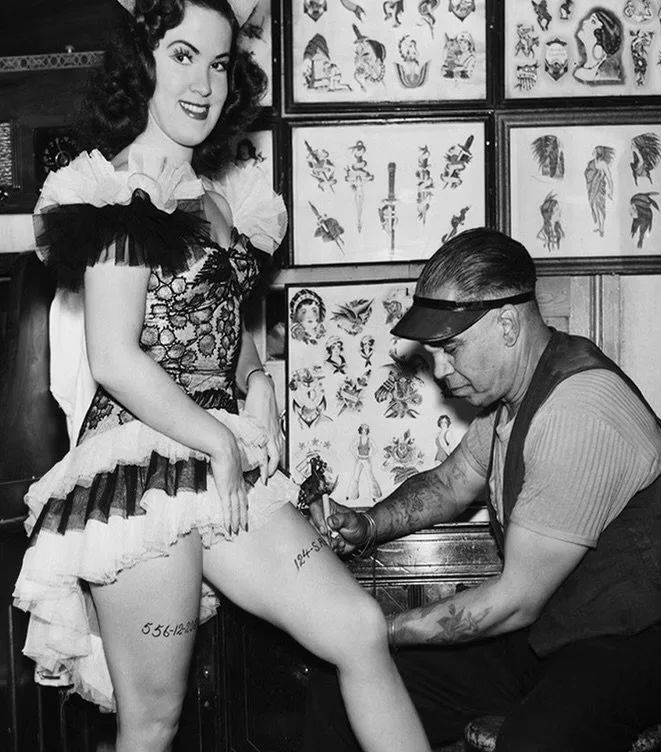
Jack Julian tattooing actress Doris Sherrell’s address nd social security number on her legs, 1942
However, one of the more prominent and important names was Harry V. Lawson. Lawson was an established tattooer whose career intersected with the networks of artists working throughout California and other port cities. Regarded as one of the founding father’s of American Traditional Tattooing, he was born in Australia before eventually making his way to The Pike and Long Beach.
Between his time on the Pike, Lawson would eventually open a shop here in San Diego. A photograph preserved through San Diego’s historical collections and reproduced in later accounts shows Lawson tattooing a customer in San Diego in 1941. The image provides a valuable firsthand visual record of the trade during a period when military tattooing was deeply embedded in local life.
These early artists worked in a different world from the custom tattoo studios of today. Tattooers relied heavily on reusable designs, hand-painted flash, personal experience, and the steady stream of customers passing through their neighborhoods. Their work helped establish the visual language that would become synonymous with classic American tattooing.
Harry Lawson and Owen Jensen: A Connection to Tattooing’s Golden Age
In 1940, legendary tattooer and machine builder Owen Jensen traveled to San Diego to work with Harry Lawson. Jensen was an important figure in American tattoo history, known for manufacturing tattoo machines and producing designs that circulated among working tattooers.
His arrival connected San Diego to a wider professional network that extended throughout the West Coast and beyond. Tattooers frequently moved between cities such as Los Angeles, Long Beach, San Diego, San Pedro, and Honolulu, following the same maritime routes as their customers. Skills, equipment, flash designs, and artistic influences traveled with them.
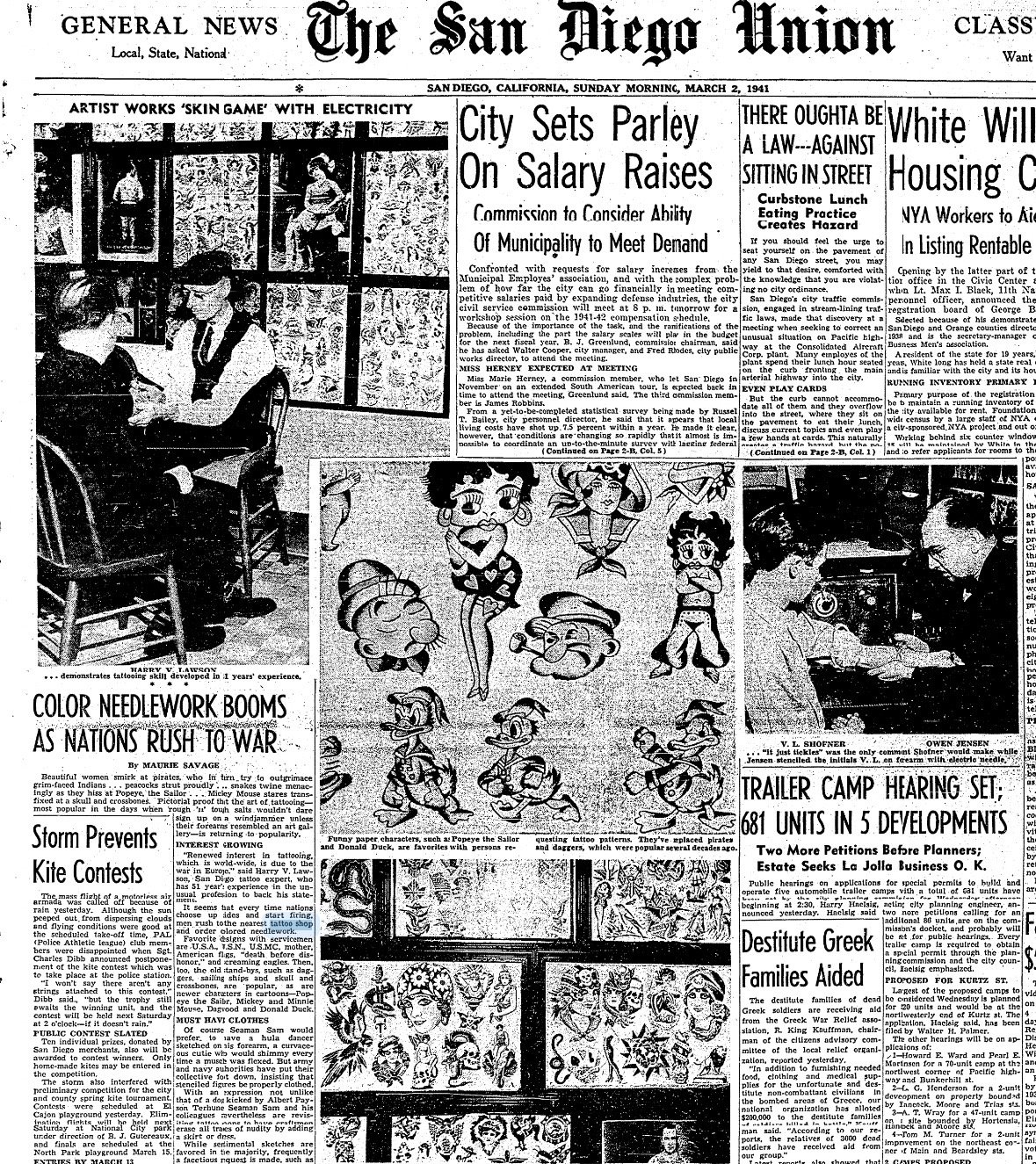
Sunday Morning, March 2, 1941: Featuring both Lawson and Jenson
Both Lawson and Jensen’s careers demonstrate that the city was connected to the broader American tattoo trade well before the postwar generation of shops became famous.
A Port City Built on Military Tattooing
To understand why San Diego became such an important tattoo town, it is necessary to understand its relationship with the military.
San Diego’s naval installations, Marine Corps bases, waterfront, and commercial port brought generations of service members into the city. Sailors and Marines often sought tattoos while on leave, before deployment, after returning home, or to commemorate milestones in their service.
For many, a tattoo was more than decoration. It could represent a ship, a deployment, a loved one waiting at home, a hard-won achievement, or a promise to return. Tattoos also connected service members to a shared visual culture, with designs and meanings passed between generations.
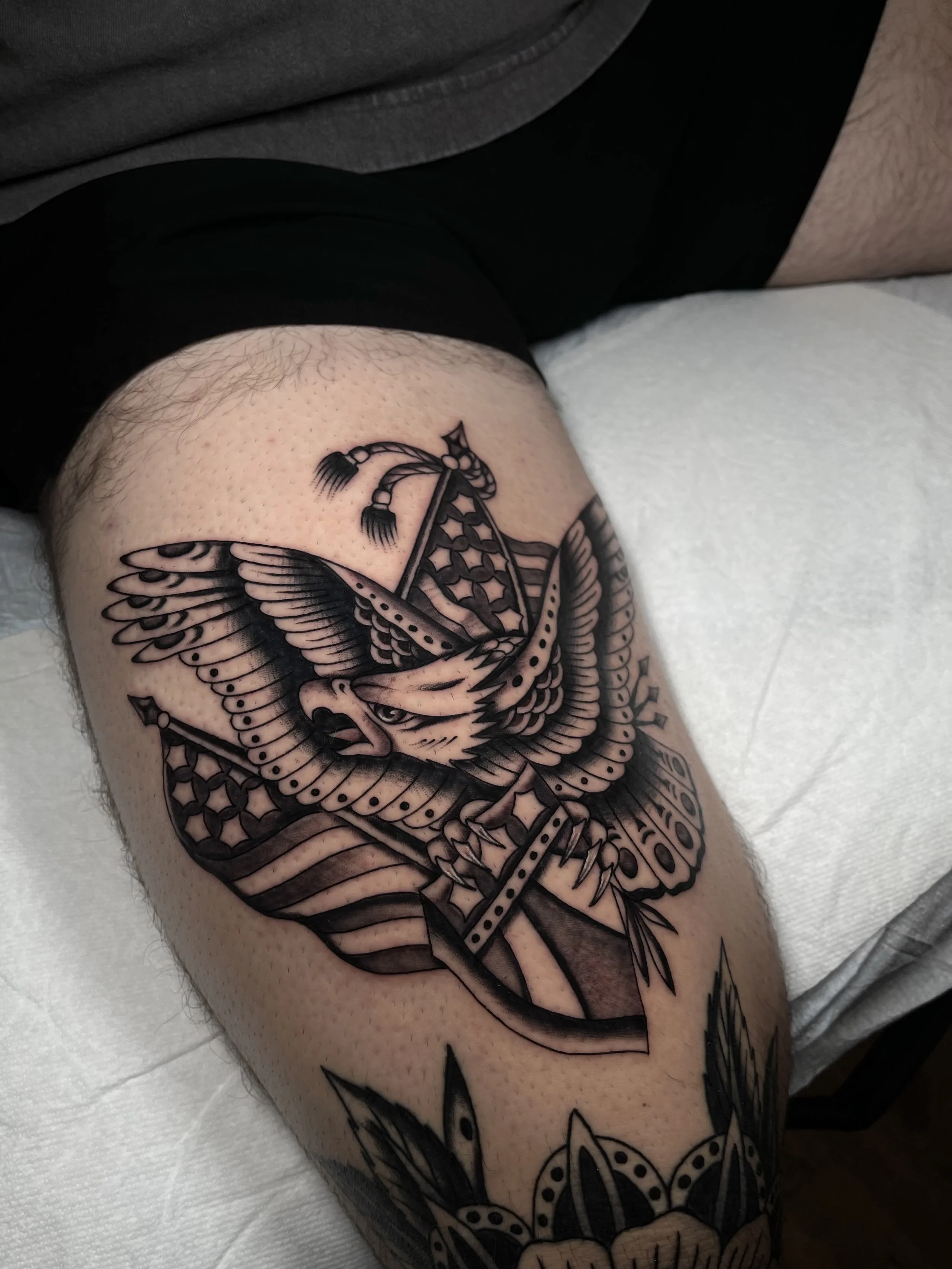
Eagle and Flags by Casey Sullivan done at Rose Tattoo Point Loma San Diego
Anchors, fully rigged ships, swallows, eagles, patriotic imagery, pin-ups, daggers, hearts, and military insignia became enduring parts of the American traditional vocabulary. The bold outlines and strong colors of these designs made them recognizable and helped preserve their impact over decades.
San Diego’s tattooers adapted to the people walking through their doors. A customer might want a small anchor or a simple name, while another might return over multiple visits to build a sleeve or commemorate an entire career at sea.
The relationship worked both ways. Military customers sustained tattoo shops, while the shops helped preserve and circulate the imagery and rituals associated with naval life. The resulting culture became one of San Diego’s most distinctive contributions to American tattooing.
Painless Nell, Ace Tattoo, and the Downtown Shops
Among the stories that connect the early downtown scene to today’s tattoo culture is that of Painless Nell Bowen, her sister, and an associate named Cliff. According to a firsthand historical account reproduced in the National Tattoo Association newsletter Flo’s 2 Bits, they operated a small tattooing space behind a penny arcade on Broadway.
The account describes a modest working shop that belonged to an older generation of tattooing. It was not a polished contemporary studio. It was a practical business serving the customers who came through the door, in a period when tattooing was still strongly associated with sailors, soldiers, and working-class neighborhoods.
The same account says that, after Nell’s death in 1971, Zeke Owen took over the space and it became Ace Tattoo. Other retrospective accounts commonly date Ace’s origins to 1947, although the exact relationship between that reported founding date and the earlier operation deserves further archival investigation.
What is clear is that Ace became an important name in San Diego’s tattoo history. Its story illustrates how an established tattooing space could survive changes in ownership while carrying its neighborhood history forward.
The shop eventually became associated with Ocean Beach, where it remains part of the community’s tattoo identity. Its history is a reminder that a tattoo shop’s legacy can extend beyond the name on the sign: it can survive through the artists who work there, the customers who return, and the traditions carried into each new generation.
Tahiti Felix’s Master Tattoo: A Downtown Institution
Another cornerstone of San Diego tattoo history began in 1949, when Felix Lynch, known as Tahiti Felix, established Master Tattoo at 317 F Street downtown.
Felix had learned the trade through the older Southern California tattooing world, including the legendary Pike in Long Beach. He brought that experience to San Diego and built a shop that became a lasting part of the city’s traditional tattoo culture.
Master Tattoo’s downtown location placed it close to the waterfront and the sailors who sustained so much of the local trade. Its longevity reflects both the strength of that customer base and the importance of continuity in tattooing.
Over the decades, the shop changed locations, but its identity remained rooted in classic American tattooing. Its original flash, vintage machines, photographs, and other artifacts preserve a tangible connection to the era when tattooing was practiced in small parlors serving a steady flow of military customers.
Today, Tahiti Felix’s Master Tattoo Parlor & Museum continues to operate in the Gaslamp Quarter. It is one of the most visible living links between San Diego’s early tattooing history and the modern city.
The shop’s story also demonstrates the importance of family and artistic lineage. Tattooing was often taught through personal relationships, observation, practice, and years of working alongside experienced artists. Knowledge passed from one generation to another in ways that cannot be fully captured by a photograph or a dated business license.
Doc Webb and the Tattooers Who Shaped the Next Generation
Another important figure in San Diego’s history was Doc Webb, whose downtown shop became a familiar destination for tattoo customers.
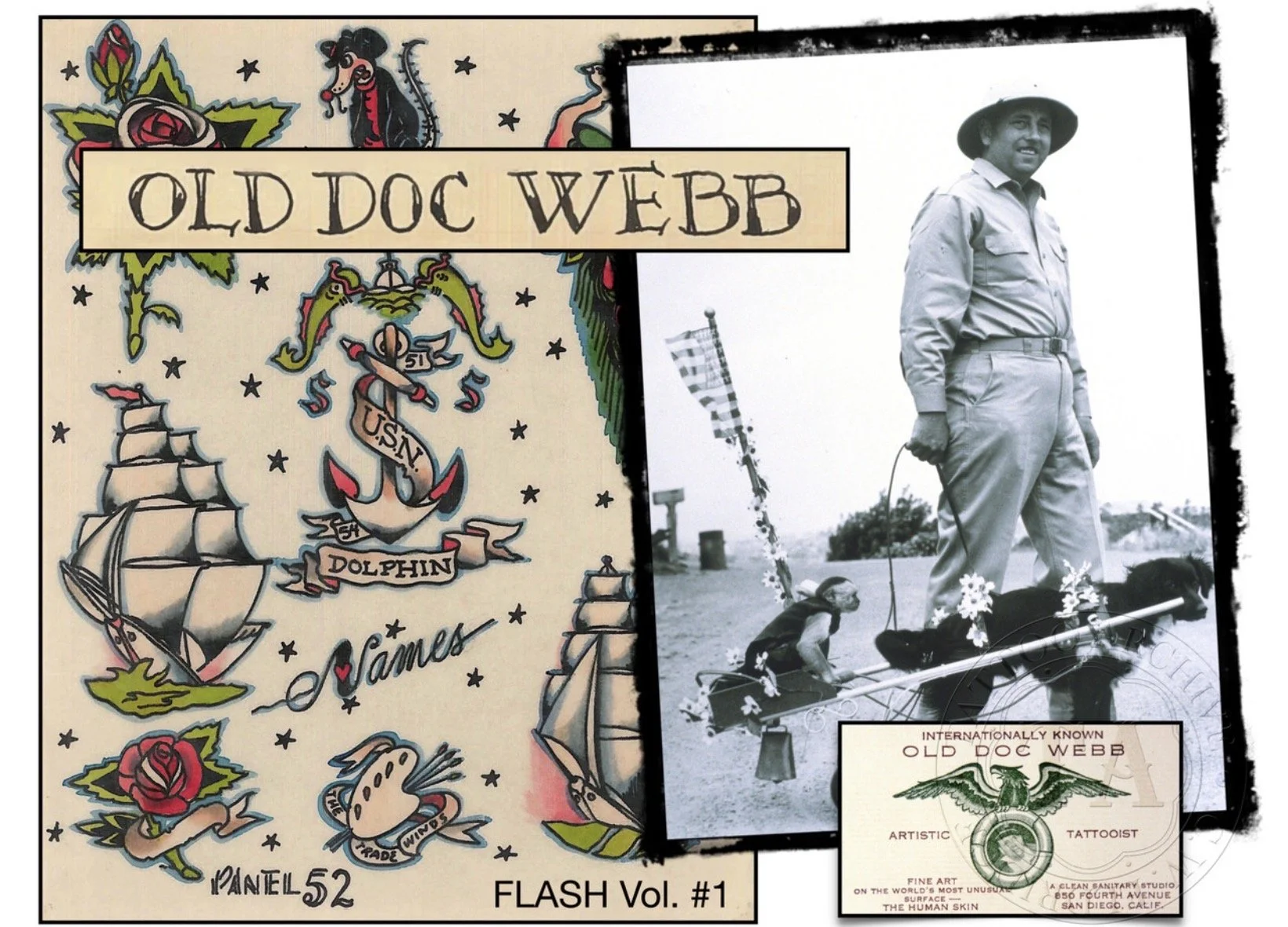
A 1972 San Diego Reader profile described Webb working in his shop near Horton Plaza, tattooing customers and drawing from walls covered with designs ranging from hearts to serpents and sea monsters. The article captured a working environment that now belongs to a different era of tattooing.
Webb’s later shop is documented at 850 Fourth Avenue. Ed Hardy recalled encountering Webb’s shop in the early 1960s, and later accounts identify the Fourth Avenue address as an important location in Webb’s career. The exact date Webb first opened a San Diego shop remains uncertain, but his documented presence places him firmly among the city’s influential tattooers.
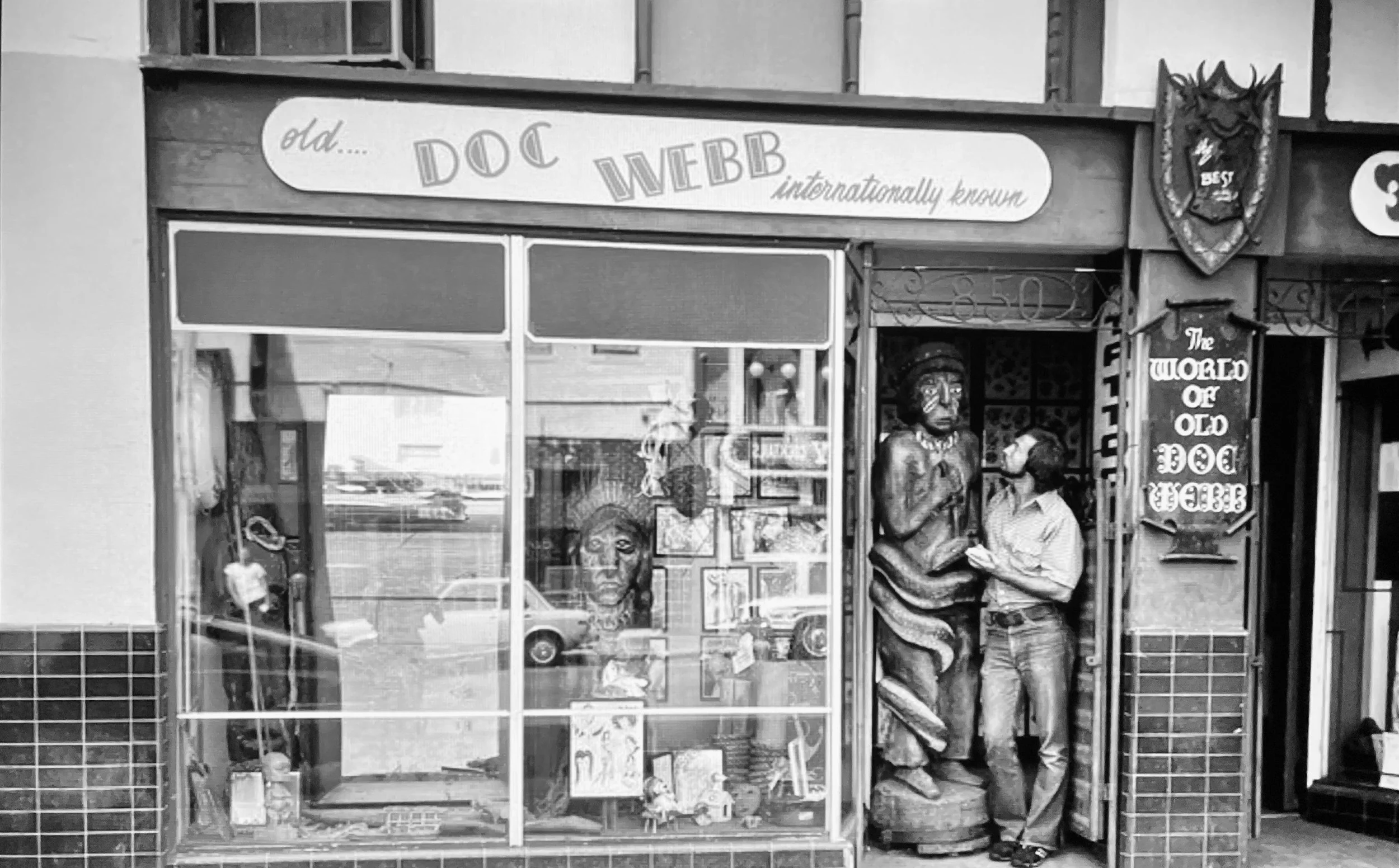
Webb’s importance extends beyond the tattoos he made. He was part of the professional environment in which younger artists developed their skills, learned to work efficiently, and encountered the demands of a busy military market.
One of those younger artists was Ed Hardy.
Ed Hardy’s San Diego Years: Doc Webb, Zeke Owen, and Mike Malone
Ed Hardy would become one of the most influential figures in modern tattooing, but his early career included time working in San Diego.
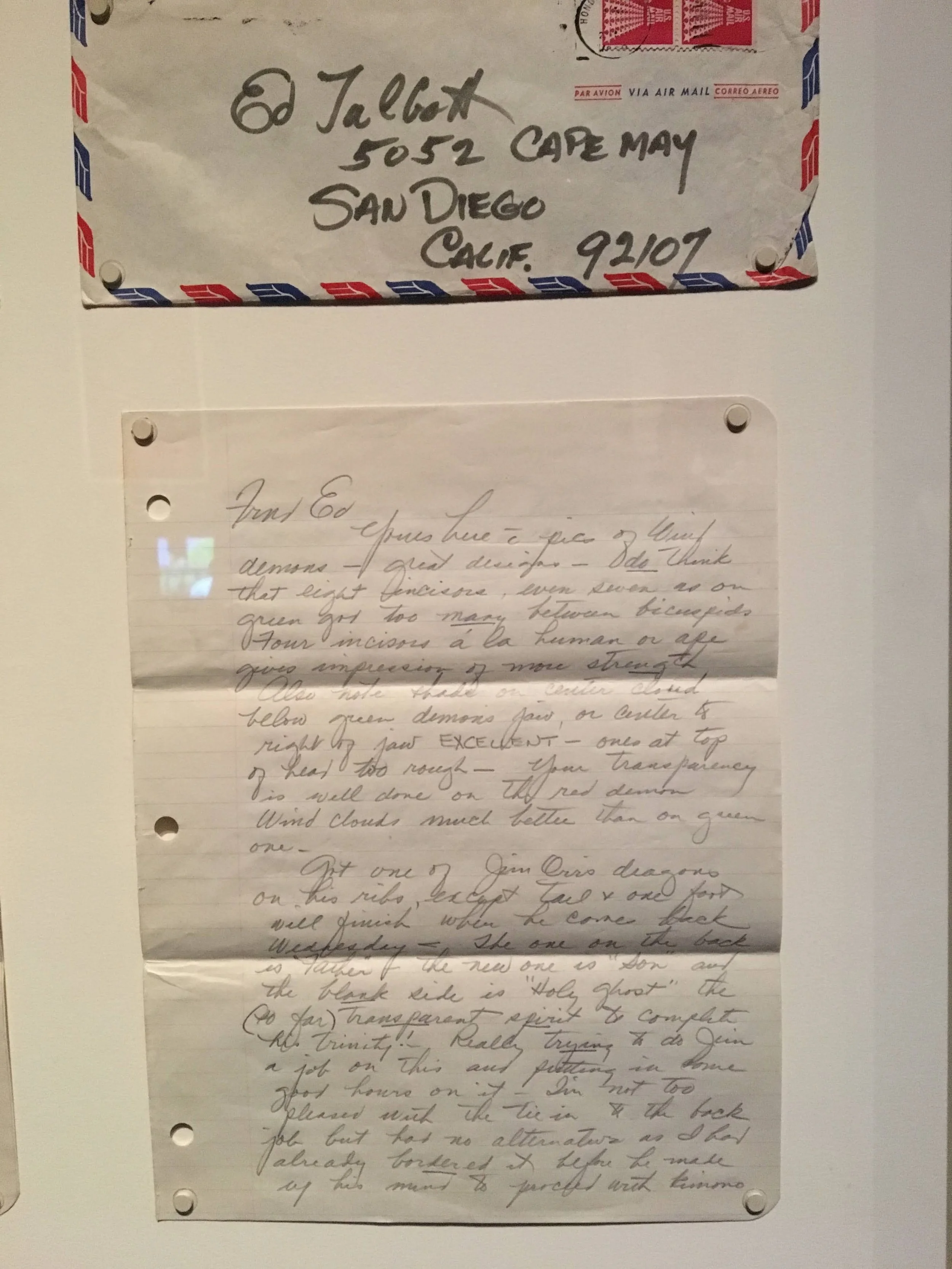
In 1969, after opening a shop in Vancouver and briefly working in Seattle, Hardy returned to Southern California and began working under Doc Webb. Hardy later recalled how busy San Diego was during the Vietnam War, with thousands of sailors and soldiers passing through the port.
That environment gave him an opportunity to develop his technique and gain experience working with customers. It also exposed him to the practical realities of traditional tattooing in a major military city.
Hardy’s path also intersected with Zeke Owen and Mike “Rollo” Malone at Ace Tattoo. Historical accounts from the Worldwide Tattoo Museum describe the connection between Hardy, Owen, and Malone, placing Ace within the network of artists who helped shape the next generation of tattooing.
Owen influenced Malone’s technical and artistic development, while the relationships among these artists connected San Diego to other important centers of the trade. Malone would eventually take over Sailor Jerry Collins’s Honolulu shop after Jerry’s death in 1973, continuing another important branch of American tattoo history.
Hardy’s own artistic direction eventually took him to Japan, where he studied with tattoo master Kazuo “Horihide” Oguri. He later returned to San Francisco and opened Realistic Tattoo, helping expand the possibilities of custom tattooing by bringing Japanese artistic structure and imagery into conversation with Western tattoo traditions.
His San Diego years were one part of that larger journey, but they remain significant because they place the city inside the story of an artist who helped change the direction of tattooing worldwide.
The Gulf War and the Decline of Downtown Tattooing
For decades, San Diego’s tattoo business benefited from the steady flow of sailors and Marines moving through the city. But a market so closely tied to military activity was also vulnerable to changes in deployment, military policy, and the local economy.
A January 1991 report in the Los Angeles Times, titled “Point Isn’t Lost on Tattooers—War Hurts,” documented the effect of the Gulf War on local tattoo shops. According to the report, nearly 20 tattoo parlors had operated in downtown San Diego in the late 1970s, but by January 1991 only two remained downtown.
The deployment of more than 50,000 sailors and Marines from the San Diego area to the Persian Gulf contributed to a sharp decline in customers. Tattoo artists described a business that had already begun to slow before the war made the situation more difficult.
The irony was striking: military service had helped build San Diego’s tattoo economy, yet the departure of military customers during a major conflict hurt the very shops that had served them for generations.
The industry also had to adapt to changing tastes and a broader customer base. Tattooers increasingly welcomed women, convention visitors, and civilian customers who were seeking tattoos for reasons beyond traditional military milestones.
This period is an important reminder that the survival of tattooing has never been guaranteed. Shops can disappear when a neighborhood changes, when customers move away, or when economic conditions shift. The artists and traditions that remain are often those able to adapt without losing the foundations of their craft.
From a Handful of Shops to a Citywide Tattoo Community
San Diego’s tattoo scene eventually expanded far beyond the small downtown cluster described in the 1991 newspaper reports. New neighborhoods developed their own shops, artists built distinct styles, and tattooing became part of everyday life rather than an activity associated primarily with sailors and soldiers.
Ocean Beach, North Park, Pacific Beach, and other communities became home to artists serving increasingly diverse customers. The growth of custom tattooing also created new opportunities for artists to develop individual approaches while remaining connected to older traditions.
Yet the expansion of the industry brought a new challenge: how to preserve the knowledge and artistic standards that had been built over generations.
The history of tattooing is not simply a story of machines becoming more sophisticated or shops becoming more numerous. It is a story of drawing, composition, technique, mentorship, and an understanding of why certain designs have endured.
Classic flash remains an important part of that story. A well-designed eagle, ship, panther, rose, or dagger is not merely a nostalgic image. These designs reflect decades of experimentation and refinement by tattooers who learned how to make work that reads clearly, heals well, and holds its character over time.
The continued practice of traditional tattooing keeps that visual language alive.
Rose Tattoo and the Tradition That Continues
At Rose Tattoo in Point Loma, we believe that understanding tattoo history is part of understanding the craft itself.
Our focus on fine-line and single-needle black-and-grey work alongside American traditional tattooing reflects the range of approaches that coexist in the modern tattoo world. But our appreciation for classic tattooing goes beyond offering a particular style. It means recognizing the artists, shops, and traditions that made the work possible.
Classic flash remains central to that connection. The designs that filled the walls of earlier tattoo parlors helped define the visual language of American tattooing. Preserving an appreciation for that artwork means keeping its history visible, studying its composition, and understanding why those images continue to resonate with new generations.
San Diego’s history makes that responsibility especially meaningful. The city’s tattoo culture was built by working tattooers who served their communities, developed their skills through experience, and carried their knowledge forward. Their stories survive through historical photographs, old shop records, vintage flash, and the memories of the people who knew them.
We also recognize that tradition is not the same as standing still. Tattooing continues to evolve, and today’s artists bring new techniques, ideas, and personal perspectives to the craft. The goal is not to recreate the past exactly as it was, but to understand what came before and build on it thoughtfully.
The legacy of Harry Lawson, Owen Jensen, Jack Julian, Doc Webb, Zeke Owen, Ed Hardy, and the shops associated with their careers is part of the larger history we want to keep alive. So are the generations of tattooers whose names never made it into books or newspaper articles, but whose work left a lasting impression on the people who wore it.
From the downtown parlors that served sailors to the traditional shops that continue to operate today, San Diego’s tattoo history is still being written.
At Rose Tattoo, we’re proud to contribute to that ongoing story—honoring classic flash, respecting the craft’s history, and carrying its spirit into the next generation.
The best way to preserve tattoo history is to keep learning it, sharing it, and practicing the craft with respect for the people who came before us.