How To Get a Tattoo Apprenticeship pt. 2: Tattoo Lineage
The Importance of Lineage
In a world dominated by social media, personal branding, and online influence, understanding lineage has never been more important for someone entering tattooing.
Today, an artist can build an audience remarkably quickly. With a strong understanding of photography, marketing, and social media, a relatively new tattooer can gain thousands of followers and suddenly have a platform large enough to influence how people perceive the craft. There is nothing inherently wrong with that. Every generation brings new ideas, and tattooing has always evolved.
But visibility and experience are not the same thing.
A tattooer who has spent 20 or 30 years working on skin has accumulated something that cannot be learned from a feed: years of observation, mistakes, corrections, healed tattoos, difficult skin, different techniques, different machines, different clients, and countless lessons that only come from doing the work over time. Yet in the age of social media, that kind of knowledge can easily be overshadowed by whoever has the better camera, lighting, editing, or platform.
This is where lineage becomes important.
Lineage is more than knowing who tattooed your mentor. It is understanding where the knowledge you are being taught came from and why certain things are done the way they are. It creates a connection between generations of tattooers and allows information that took decades to develop to continue moving forward.
Throughout tattoo history, knowledge has often been passed from one artist to another through observation, mentorship, and apprenticeship. In many traditions, specialized tattoo knowledge was entrusted to particular practitioners and passed down through generations. The same principle became deeply rooted in Western tattooing: you learned by being around people who had already put in the years.
For an apprentice, knowing your lineage means knowing who taught your teacher, who taught them, what traditions influenced them, and what lessons were carried forward along the way. It means understanding that you are not starting from zero. You are stepping into a craft that was being practiced long before social media, online tutorials, and instant access to equipment.
There is always room for the next generation. There should be. But the responsibility of an apprentice is not simply to become visible—it is to become knowledgeable.
Lineage keeps that knowledge alive. It gives the next generation something to build from rather than something to reinvent without understanding.
Tattooing is more than a career. For many, it becomes a lifestyle, a discipline, and a lifelong relationship with the craft. If you choose to enter it, take the time to learn where it came from. Respect the people who carried it before you. Learn from those who have already walked the road.
Then, when your time comes, add something of your own—and pass the knowledge forward.
Alright, let’s get into it… New York and the Birth of the Modern American Tattoo Trade
By the late 19th century, New York had become one of the most important centers of professional tattooing in America. The Bowery and Chatham Square were crowded with sailors, entertainers, sideshows, museums and tattoo shops.
One of the central figures was Samuel O’Reilly, a tattooer who established himself in New York and is best known for patenting the first American electric tattoo machine in 1891. His machine was adapted from Thomas Edison’s electric pen and fundamentally changed the speed and mechanics of professional tattooing.
But an invention is only as valuable as the knowledge surrounding it. Someone had to teach tattooers how to use these machines, build needles, tune equipment and actually put the technology to work.
That knowledge traveled through apprenticeship.
One of the most important early connections was Charles “Professor” Wagner, who became closely associated with O’Reilly and eventually took over O’Reilly’s famous Chatham Square operation. Wagner went on to become one of the dominant tattooers and equipment makers of early 20th-century New York, even patenting his own improvements to the tattoo machine.
The Flash Connection
Another important New York figure was Lew “The Jew” Alberts, who worked in the Chatham Square tattoo community and became particularly influential through tattoo flash.
Flash changed the way tattoo knowledge traveled.
Before photographs could be instantly shared online, a tattooer could create a design on paper and send it across the country. Other tattooers could study it, purchase it, copy it, modify it and eventually incorporate elements into their own work.
Tattooers exchanged designs and ideas across cities, and New York’s influence spread far beyond New York.
This is one reason tattoo history is difficult to reduce to a simple family tree. An artist didn’t necessarily learn everything from one teacher. They learned from people they apprenticed under, people they worked beside, people they met while traveling, designs they collected and tattooers whose work they admired.
The lineage was more like a web than a straight line.
From New York to California
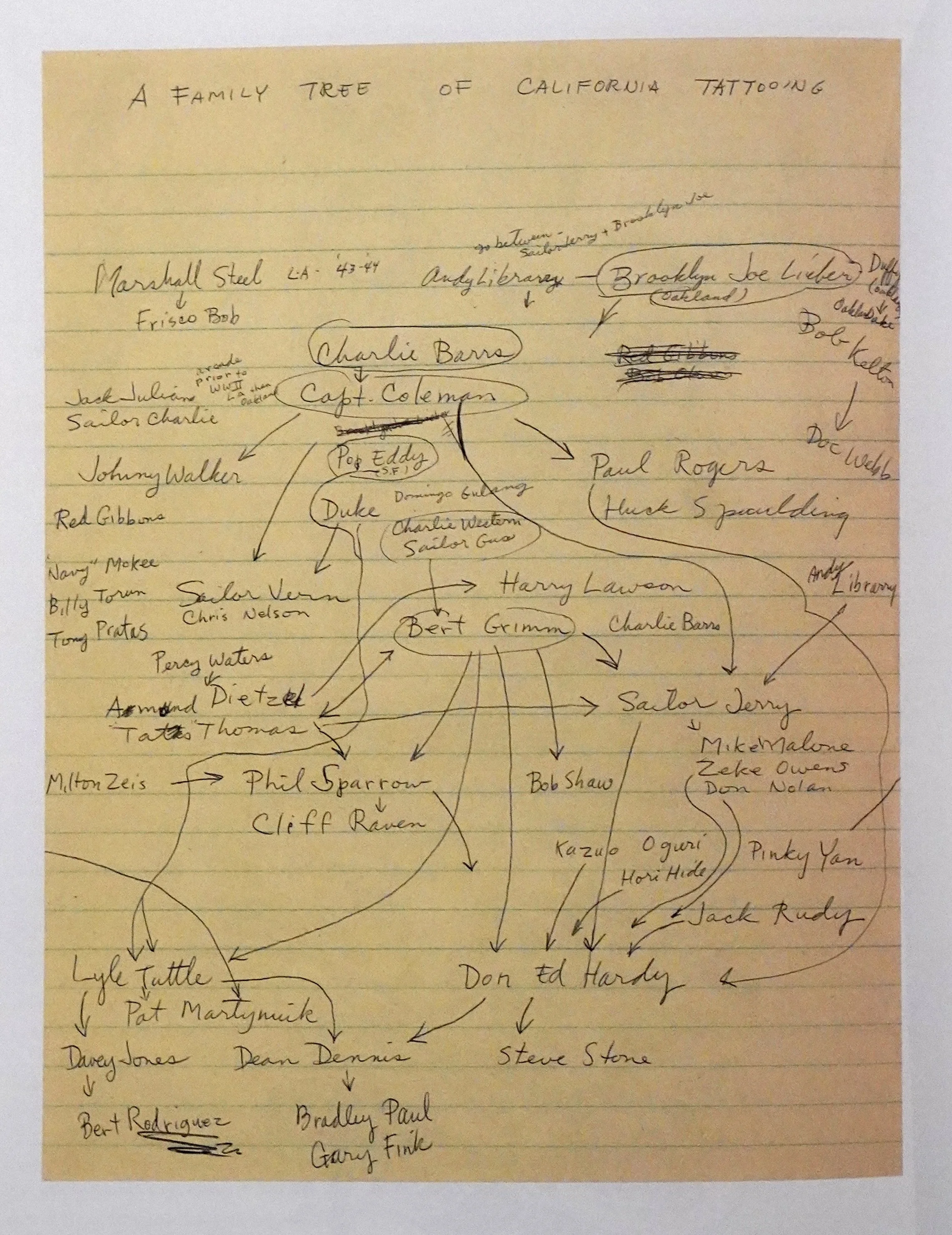
By the first half of the 20th century, tattooing had established itself throughout California. Los Angeles, San Pedro, Long Beach, San Francisco and San Diego became important tattoo centers, with sailors, soldiers, tourists and working-class customers providing a steady clientele.
One of the tattooers who helped connect these worlds was Owen Jensen.
Jensen worked in several major tattoo centers, including New York and California, and eventually spent significant time in San Diego. His career demonstrates just how mobile early tattooers were. Artists traveled, worked in different shops, exchanged designs and carried techniques from one part of the country to another.
The tattoo trade didn’t develop independently in every city.
New York influenced California. California influenced Hawaii. Tattooers moved back and forth, bringing their machines, flash and knowledge with them.
And eventually, California developed one of the most important tattoo institutions in American history.
The Pike
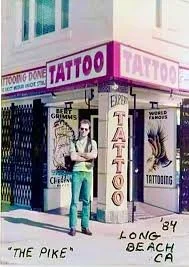
In Long Beach, The Pike amusement district became legendary in tattoo history.
Among its many attractions was the famous tattoo shop of Bert Grimm.
Grimm had already established himself as an important tattooer before arriving in California, but his Long Beach shop became one of the great gathering places for American tattooers. The Pike brought together sailors, tattooers and travelers, and the shop became part workplace, part classroom and part meeting place for the developing West Coast tattoo community.
Artists including Owen Jensen, Zeke Owen, Bob Shaw, Lyle Tuttle, Don Nolan and others passed through the broader California tattoo scene associated with the Pike.
Again, not every relationship should be described as a formal apprenticeship. Tattooers learned in different ways. Some were direct students. Some worked alongside established artists. Others absorbed techniques simply by being around them.
And that influence became the foundation of a distinctly California branch of American tattooing.
Zeke Owen and San Diego
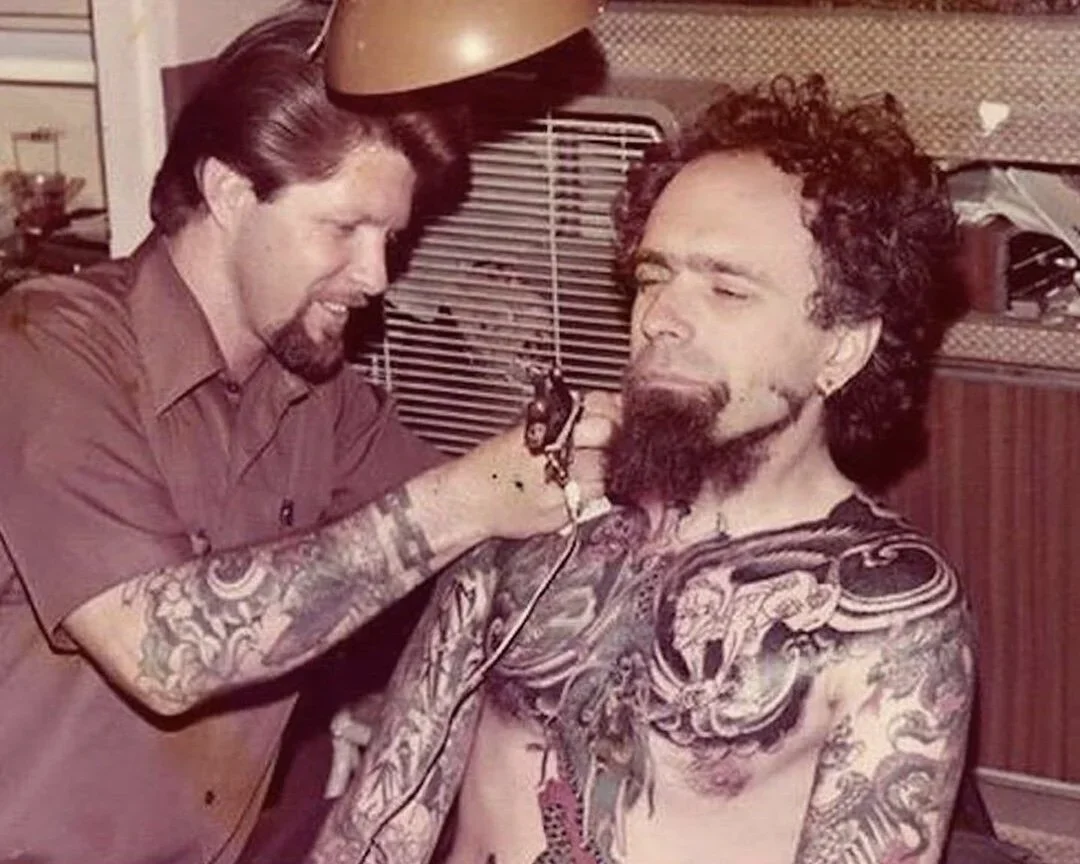
For San Diego, Zeke Owen is particularly important.
Owen entered tattooing in the 1950s and became part of the Pike’s legendary tattoo community before eventually working in San Diego. He was connected to Ace Tattoo Company, where he became an important teacher and influence on the next generation.
One of those tattooers was Mike “Rollo” Malone.
Malone’s path is a perfect example of how tattoo lineage crossed geographic boundaries. He had been exposed to tattooing in New York, moved west and worked with Zeke Owen in San Diego, and through that network encountered figures including Sailor Jerry Collins and Don Ed Hardy.
When Sailor Jerry died in 1973, Malone ultimately took over Jerry’s famous Honolulu shop.
Professor Phil Sparrow and Don Ed Hardy
Another important branch of this story runs through Samuel Steward, better known in tattooing as Professor Phil Sparrow.
Steward was unusual because he had actually been a university professor before becoming a professional tattooer. He became deeply involved in tattoo culture and documented the world around him while working under the name Professor Phil Sparrow.
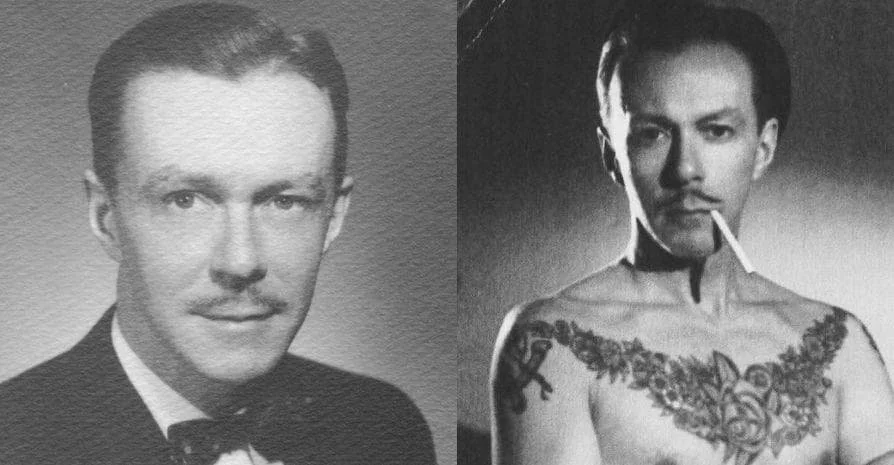
Steward became an important influence on Don Ed Hardy, introducing him to Japanese tattoo imagery and helping open the door to a tradition that would profoundly affect Hardy’s career.
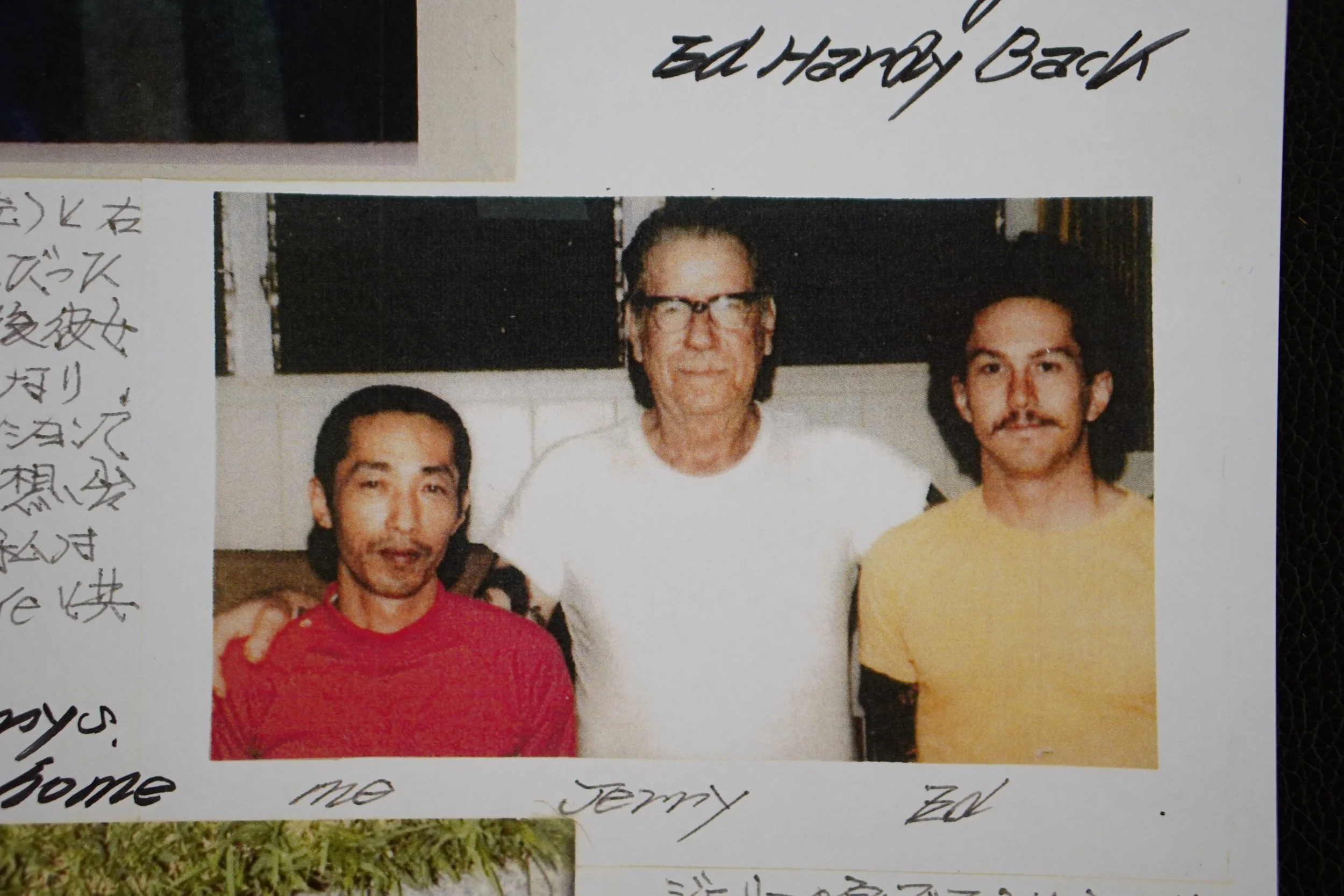
Hardy also studied with tattooers including Zeke Owen and developed a relationship with Sailor Jerry Collins.
Through these relationships, Hardy encountered both American traditional tattooing and Japanese tattooing at a level few Western tattooers had experienced.
That combination would become enormously influential.
Sailor Jerry and the Japanese Connection
Norman “Sailor Jerry” Collins became one of the defining figures of American traditional tattooing.
Working in Honolulu, Jerry developed a distinctive approach to American tattooing while also studying Japanese tattooing and corresponding with Japanese masters.
His work demonstrated that traditional American tattooing wasn’t a static style.
It could absorb outside influences while remaining unmistakably American.
Jerry’s shop eventually became another important link in tattoo lineage. After his death, Mike Malone took over the shop, carrying another branch of the American tattoo tradition from California into Hawaii.
At the same time, Don Ed Hardy was taking what he had learned from American tattooers and Japanese masters and pushing tattooing in another direction.
From Flash to Custom Tattooing
One of the major changes in late 20th-century tattooing was the growing emphasis on original, custom artwork.
For much of traditional tattoo history, flash was central to the trade. A customer chose a design from the wall, and the tattooer applied it.
Artists such as Don Ed Hardy and Cliff Raven helped push the idea that a tattoo could instead be designed specifically for one person.
This didn’t mean abandoning traditional tattooing.
It meant expanding what tattooing could be.
Hardy’s approach combined traditional American tattooing, Japanese tattooing and fine-art influences. The tattoo became not simply something selected from a wall, but an original composition designed for the body.
That evolution helped lay the groundwork for the contemporary tattoo industry.
The Apprenticeship Changes
By the 1970s and 1980s, tattooing was becoming increasingly interconnected.
Tattoo conventions brought artists together. Magazines allowed artists to see work from around the world. International travel became easier. Artists began deliberately seeking out masters whose work they admired.
The 1982 tattoo convention aboard the Queen Mary in Long Beach, organized by Ed Hardy, Ed Nolte and Ernie Carafa, is a good example of this changing world. Artists from different American tattoo traditions and countries were brought together in one place.
The old apprenticeship hadn’t disappeared.
It had expanded.
An apprentice could now learn from a local mentor while simultaneously being exposed to tattooers from across the country and around the world.
Eventually, the internet would accelerate that process beyond anything the early tattooers could have imagined.
But access to information didn’t eliminate the value of experience.
A video can show you how a machine works. It can’t tell you what a particular person’s skin is doing under the needle.
A photograph can show you a healed tattoo. It can’t teach you what it feels like to create one.
And a tutorial can explain sanitation without giving you the years of repetition required to make safe practices instinctive.
That is why apprenticeship remains relevant.
More Than Learning to Tattoo
Historically, an apprentice wasn’t simply being taught how to make a line.
They were learning an entire trade.
They learned how to prepare a station, build needles, tune machines, organize flash, deal with customers, maintain a shop and understand the business. They learned when a tattoo should be modified, how it should flow and work on the body and, just as importantly, when a tattoo should not be done.
The ultimate goal was not to create another copy of the teacher.
It was to create another tattooer capable of carrying the craft forward.
Why Lineage Still Matters
Today, tattooers have access to more information than any generation before them.
But that makes understanding lineage more important, not less.
When we look at an American traditional eagle, rose, panther, ship or dagger, we’re looking at a visual language developed and refined over generations. The designs and classic imagery has already been perfected and built to last with clarity, strength, and timelessness.
And when a tattooer studies the work of O’Reilly, Wagner, Alberts, Waters, Grimm, Jensen, Owen, Tuttle, Sparrow, Sailor Jerry or Hardy, they’re not simply studying famous names.
They’re studying the people who carried the craft before them and spent the time perfecting a design.
From the Bowery to Point Loma
The history of tattooing is ultimately a history of people passing knowledge to other people.
From Samuel O’Reilly and the Bowery, through Charlie Wagner and the Chatham Square tradition, through the flash and equipment makers who spread those ideas across the country, into Bert Grimm’s Pike, Zeke Owen’s San Diego, Sailor Jerry’s Honolulu, and Don Ed Hardy’s evolution of custom tattooing, the story is one of constant exchange.
Every generation changes something.
But every generation also inherits something.
That is what makes tattoo lineage different from simply studying a style.
A style can be copied.
A lineage is something you participate in.
The apprentice eventually becomes the tattooer. The tattooer eventually becomes the teacher. And the knowledge that was once passed to them becomes something they are responsible for passing forward.
That is how tattooing survived before the internet.
And, in many ways, it’s still how the best parts of the craft survive today.
From the Bowery to the Pike. From New York to California. From California to Hawaii. From traditional flash to custom work.
The tools have changed.
The technology has changed.
The styles have evolved.
So put down your phone, stop trying to become a comedian or a dancer for social media in the hopes of building an audience.
Learn from those who came before you. Respect what they built. Add something of your own. Then pass it on.
That is the lineage of American tattooing.