Rose Tattoo Flash Design Origins: The Tony Polito Skull
The Tony Polito cowboy skull—often called the Rough Rider —is one of those rare tattoo designs where multiple layers of American culture collide: pulp illustration, outlaw history, and traditional tattooing. Its story isn’t a straight line—it’s a lineage.
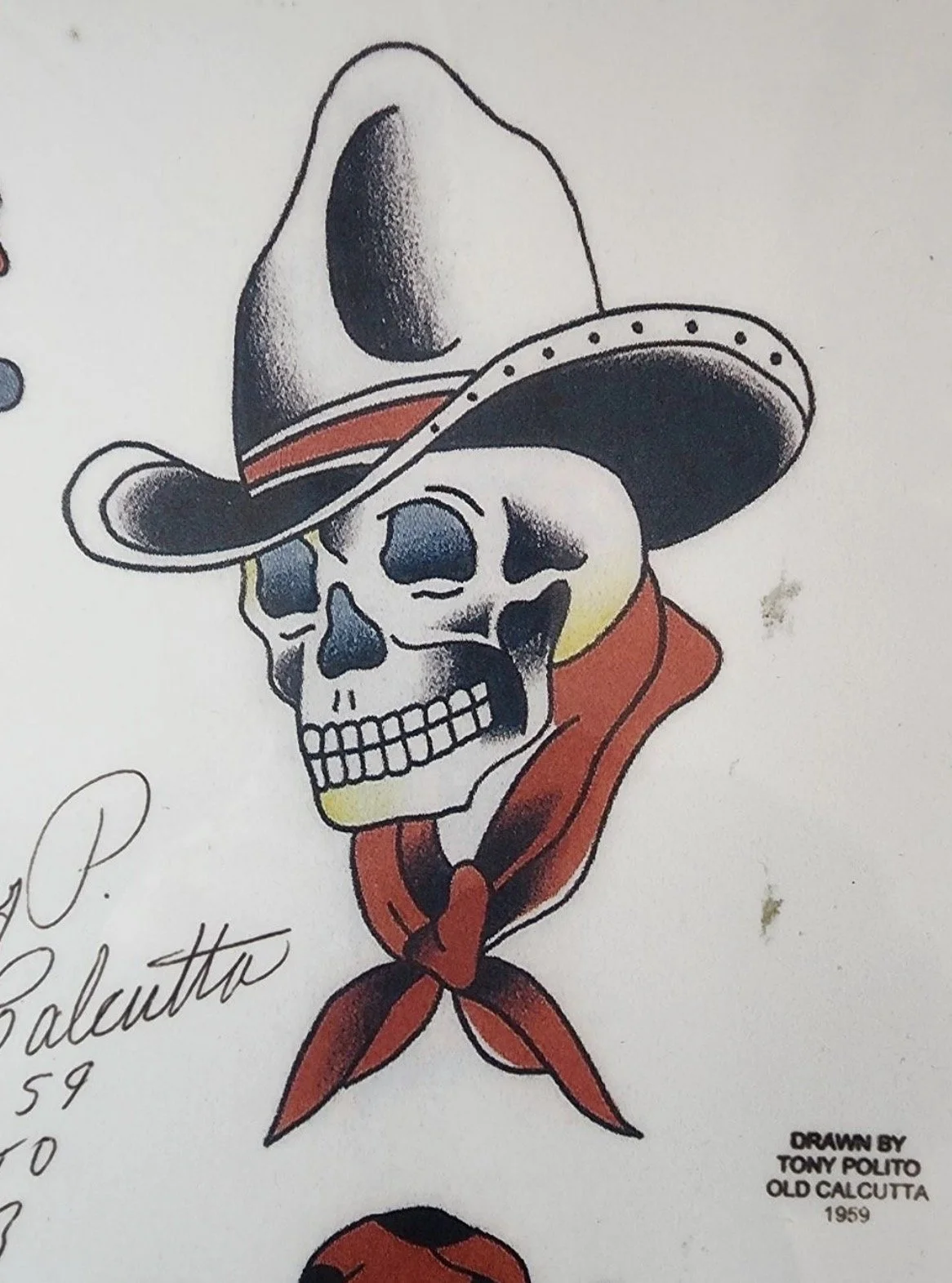
The Rough Rider Skull by Tony Polito 1959
Tony Polito started tattooing in 1959 out of a supply shed in a public Brooklyn park. His first official shop was at 646 Lefferts Ave in the Crown Heights section of Brooklyn. In 1980 he moved to 742 Lefferts Ave where he tattooed daily until 2010 when he officially retired.
Tony Polito began his tattoo career in the late 1950s in New York City out of a supply shed in a public Brooklyn park, a time when tattooing operated largely underground due to strict health regulations and eventual bans. Starting around 1959, Polito learned the trade in a rough, street-level environment, tattooing out of backroom shops and building his reputation through word of mouth rather than formal apprenticeships. His early years were shaped by the gritty culture of mid-century NYC—working alongside hustlers, bikers, and working-class clients—which influenced his bold, no-nonsense approach to American traditional tattooing.
The original shop at 646 was affectionately called Old Calcutta. He carried the name over to 742. Here’s the story behind the name:
Tony Polito: “Stanley Moskowitz used to ask me “how’s things at Old Calcutta?”
Old Calcutta is in India….it’s a bad place…and this was a bad place. This wasn’t a good name!!! The people who came here were baaaaad. When I was building this place, my friend told me don’t build anything that they can break, no glass, nothing nice!!…and build the toilet like they have in jail so they can’t break anything…..because they will break stuff, just to get their money’s worth cause they gotta pay for the tattoo”
Tony listened to his friend and built a sturdy little shop in the basement of a house built in the early 20th century. He opened everyday after 5pm. He opened at 5pm because the NYC Health Dept closed at 5pm and he wanted to avoid them becoming aware of his illegal activity of tattooing. He tattooed behind bulletproof glass. He tattooed in “Old New York.” In a neighborhood nicknamed “PigTown.”
This foundation would later define both his style and the enduring impact of his flash designs, including the now-iconic cowboy skull.
Origins: Pulp Art & Early American Imagery (1930s–1940s)
The visual design of the Polito skull traces back to 1930s pulp illustration, not tattooing itself.
The closest documented origin is the 1937 novel “Death on a Dude Ranch”, whose cover featured a grinning skull in a cowboy hat—nearly identical to the tattoo we know today.
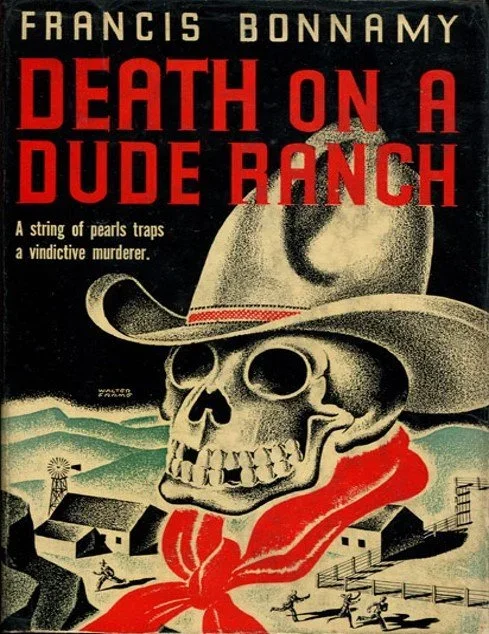
Francis Bonnamy’s Death on a Dude Ranch with the prominent artwork of the classic cowboy skull
This era of pulp fiction leaned heavily into Western outlaw mythology, blending death imagery with rugged individualism.
Through the 1940s–50s, tattooers like Cap Coleman and others routinely pulled from magazines, pulp covers, and ephemera rather than fine art or anatomical references, spreading these motifs into early flash. Early tattoo pioneers, like Coleman, likely adapted this imagery into flash sheets during the mid-20th century.
At this stage, the image wasn’t yet iconic—it was just one of many Western-themed motifs circulating in early American tattoo flash.
Dr. Louis Cruzes Antikamnia Calendar
Another heavily referenced concept to the start of the Rough Rider skull is that taken from the Antikamnia Calendar. Between 1862-1898 Dr. Louis Cruzes, a physician and anatomy lecturer, drew a series of humorous skulls for the Antikamnia Chemical Company. However, the idea that the Tony Polito cowboy skull was directly taken from a “Dr. Louis Cruzes skull calendar” doesn’t hold up well when you lay the timeline out—there’s no widely documented or verifiable record of that calendar influencing tattoo flash in mid-century America. Instead, the evidence leans much more heavily toward earlier mass-media illustration. In the 1930s, American pulp publishing was flooded with Western and crime imagery, and by 1937, the novel Death on a Dude Ranch featured cover art showing a grinning skull in a cowboy hat—arguably the closest known visual ancestor to the later tattoo design. By the time Polito began tattooing in 1959, the cowboy skull concept was likely already circulating in some form; his contribution was refining it into the bold, simplified “Rough Rider” version that became standard. The “Dr. Cruzes calendar” theory appears to be a much later attribution—likely retrofitted folklore rather than a primary source—whereas the pulp novel cover fits cleanly into the known pipeline of how tattoo imagery was actually sourced and transmitted in that era.
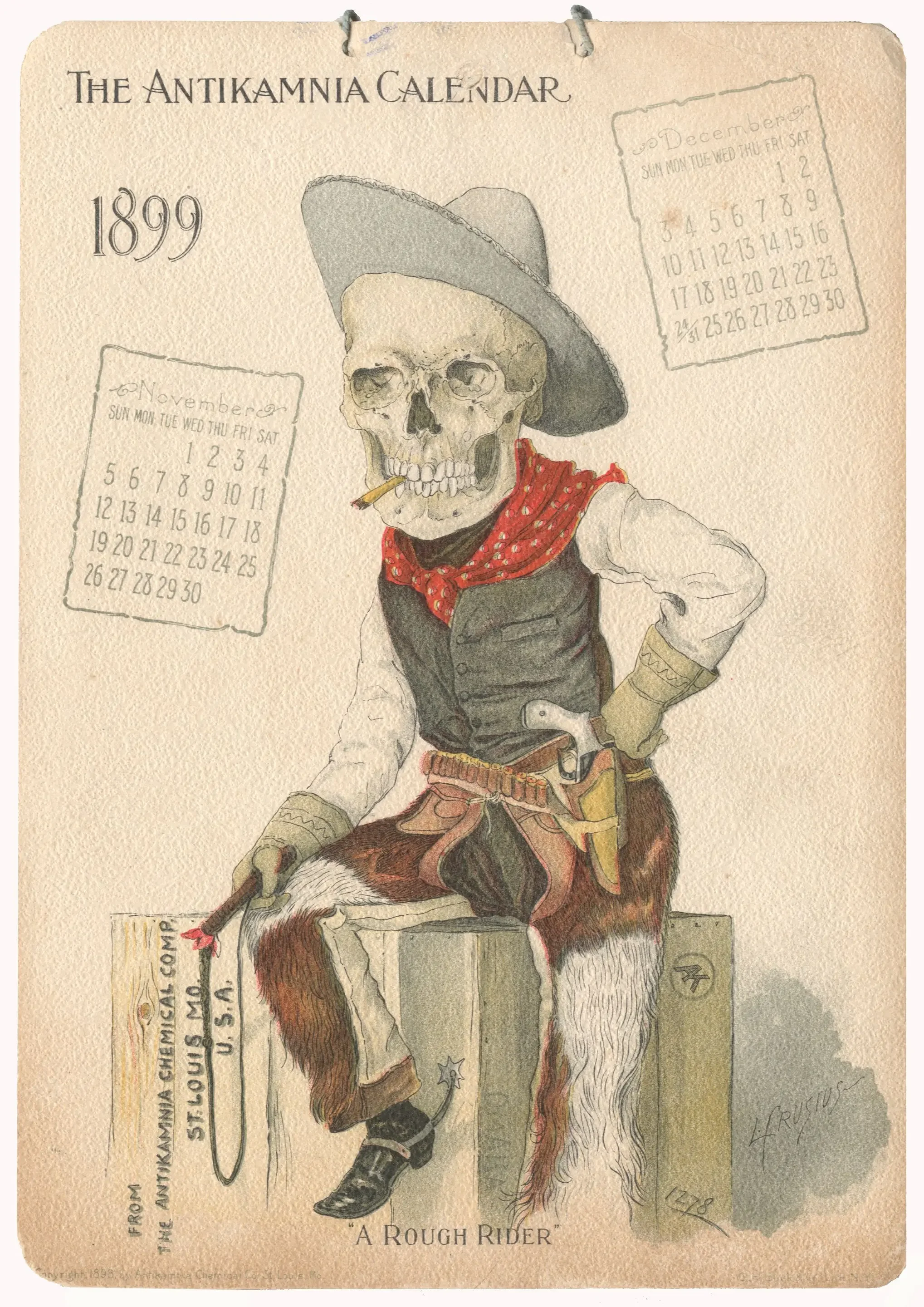
The cowboy skull from the 1899 Antikamnia Calendar
The Polito Era: Refinement & Identity (1950s–1970s)
Polito did not invent the cowboy skull—but he refined it into the version that stuck.
Flash is definitely Tony’s thing. He always says machines and designs are the most important part of the trade. He tells me “without these two things you can’t conduct a successful tattoo business, your designs and your machines gotta be on the money!!!”. … They (flash designs) were all the old classics simplified and made easy.” Schiefley told Tony “these are made for the trade….for the industry” He made designs that you didn’t have to stand on your head to do.”
Tony’s version of the Rough Rider skull emphasized the “Brooklyn Style” of tattooing which he describes as “Heavy Tattoos” are the brightest & boldest tattoos you could imagine. Just like Cap Coleman, Heavy black saturation, Bold, readable linework, but with Tony’s flair adding a more aggressive, grinning expression to the skull.
He called it the “Rough Rider”, tapping into American frontier mythology, specifically the legacy of Theodore Roosevelt’s Rough Riders with the idea of someone who lives hard and accepts consequences
In Polito’s shop—operating during a time when tattooing was illegal in NYC—the design became a badge of identity among criminals, bikers, and street figures.
This is where the skull transforms from illustration to a symbol.
The “Crazy Sal” Explosion (1980)
The design’s rise to mainstream notoriety came from a single moment.
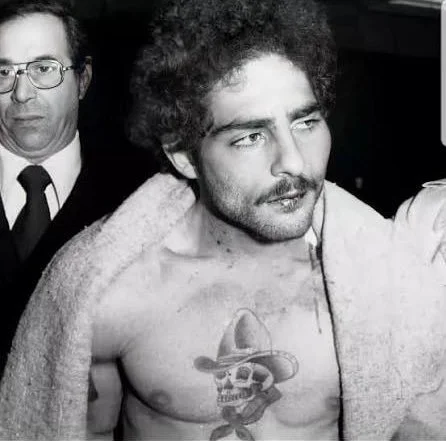
In 1980, a Brooklyn murder suspect named Salvatore DeSarno (nicknamed “Crazy Sal”) was arrested.
“Crazy Sal” — born Salvatore DeSarno — became an unexpected part of tattoo history in 1980 when his arrest in Brooklyn was widely covered by newspapers, including a striking photo of him shirtless with the Rough Rider (cowboy skull) tattoo prominently displayed across his chest. The image circulated heavily in the media, and the tattoo quickly picked up the nickname “Crazy Sal skull,” forever tying it to his notoriety. While the design itself had already existed and been popularized by Tony Polito, DeSarno’s case amplified its visibility and gave it a raw, real-world association with crime, toughness, and outlaw identity—cementing the tattoo’s place in American traditional culture.
There’s no solid, documented proof that Tony Polito personally tattooed Salvatore DeSarno (“Crazy Sal”). It’s widely assumed within tattoo circles that the Rough Rider skull on DeSarno’s chest likely came from Polito’s shop or flash—since Polito popularized that exact design in New York at the time—but no confirmed record or firsthand account ties Polito directly to doing the tattoo himself. Like a lot of tattoo history from that era, especially in underground NYC, the details are murky, and the story lives more in tradition and word-of-mouth than verifiable documentation.
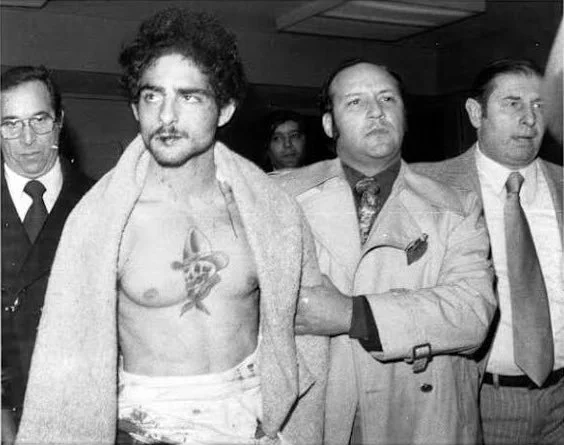
A widely published newspaper photo showed him shirtless—with the Polito skull tattooed prominently on his chest.
The Rough Rider Skull Today
Tony Polito’s legacy continues to resonate with a new generation of tattooers through his bold, iconic imagery and commitment to strong, readable design rooted in traditional tattooing. Artists today draw from his approach to composition, symbolism, and repeatable flash—principles that remain foundational in an industry increasingly driven by trends and digital exposure. As modern tattoo culture evolves through online platforms and global sharing of artwork, Polito’s influence stands out as a reminder of timeless craftsmanship, encouraging younger artists to balance innovation with respect for classic imagery and the historical roots of the trade.
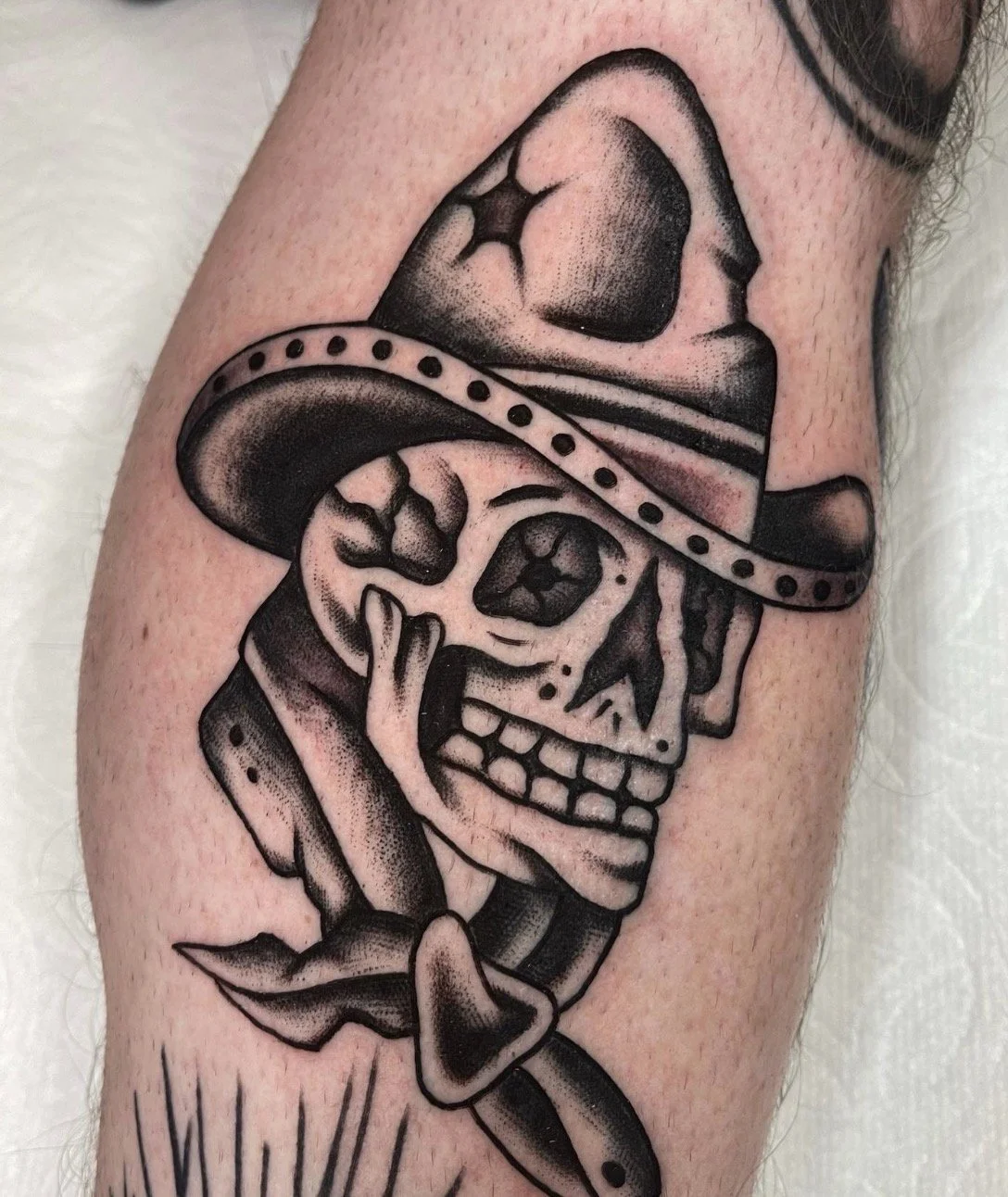
Rough Rider Skull by Casey Sullivan at Rose Tattoo, San Diego California
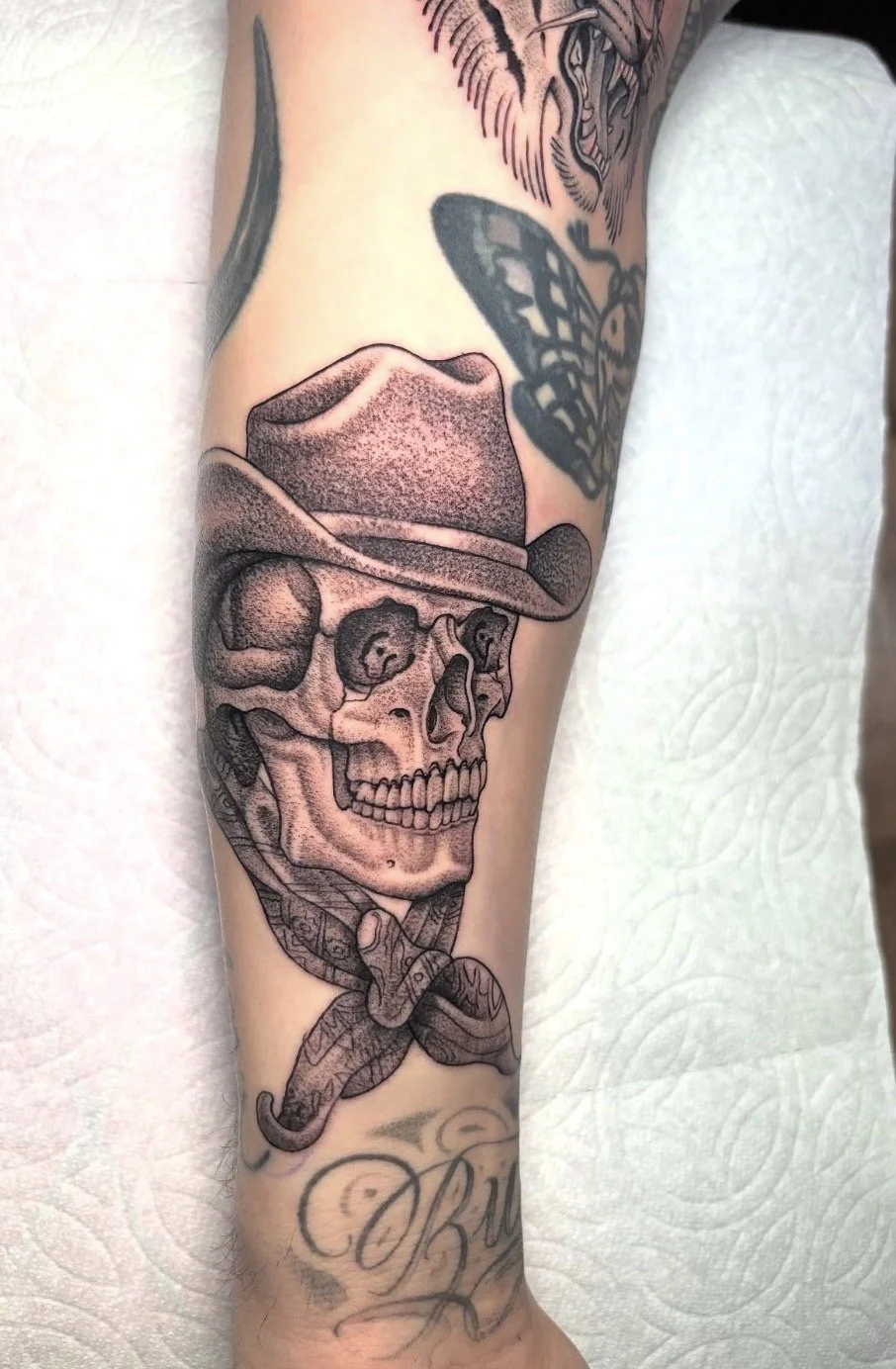
Rough Rider Skull reimagined and drawn for a realism approach by Daniel Collins at Rose Tattoo, San Diego California
At Rose Tattoo San Diego, the influence of Tony Polito and other classic American Traditional tattooer’s artistry runs deep. Many of our artists draw inspiration from their approach to strong, bold, linework and shading — blending traditional roots with the loud punchy colors used in classic designs to recreate the Brooklyn Style of tattooing.
If you’re looking for a bold American Traditional tattoo in San Diego, our team continues the legacy that To y Polito helped pioneer: clean lines, smooth dark black gradients, and timeless imagery.
👉 Book your appointment today to get a tattoo inspired by Tony or pick some flash off of the walls to continue the tattoo legacy and history.