The Sacred Profane: Tattooing in the MEDIEVAL Ages
Marking the Body Across Time
Tattooing is one of humanity’s oldest forms of body modification as one of the most visible and personal forms of self expression and embraced across the western world as a statement of identity. However, tattoos have represented different meanings in different time periods. Prehistoric tattooing dating back over 5,000 years primarily served as therapeutic, spiritual, and social markers. Evidence from mummies such as Otzi the Iceman suggest tattoos were used as early medical treatments such as acupuncture, to manage pain, alongside signifying tribal status, protection against evil, or coming of age milestones. The oldest known tattoos, found on Otzi (c.3300 BCE) consisted of 61 lines and dots located over joints.
In the classical Greek world tattoos would evolve to become mostly negative and viewed as a sign of disgrace, often involuntary — branded onto criminals, prisoners, and slaves to mark ownership. The Greek word for tattoo was even called “stigmata” which became synonymous with shame and disgrace. Widespread negative connotations of tattoos in Ancient Greece can be attributed to the manner of which they were introduced to the Greeks. According to historian Herodotus (c. 484-425 BC), Greeks first learned of tattoos from Persians in the 6th Century BC. It was a common Persian practice at the time to tattoo subordinates forcibly. By the 5th century BC, frequent literary allusions indicated that Greeks were regularly tattooing criminals, slaves, and prisoners of war.
While viewed largely as a mark of shame in Greek society, tattoos were viewed in a more positive light in other ancient cultures outside of Greece and Rome such as Ptolemy IV Philopator, a Macedonian-Greek pharaoh of Egypt of whom had tattoos of ivy leaves, symbolizing his devotion to Dionysus, the god of wine and theater. Thracian women, known also as Maranda, especially those involved in the killing of Orpheus, were often depicted with geometric decorative tattoos, which many regarded as a sign of high noble birth. In Egypt, the earliest evidence of tattoos dates back to the 11th Dynasty where mummies were discovered to have tattoos with significance. Herodotus also writes that Egyptian slaves could receive asylum if they entered a temple of the Egyptian god Hercules and received sacred tattoos.
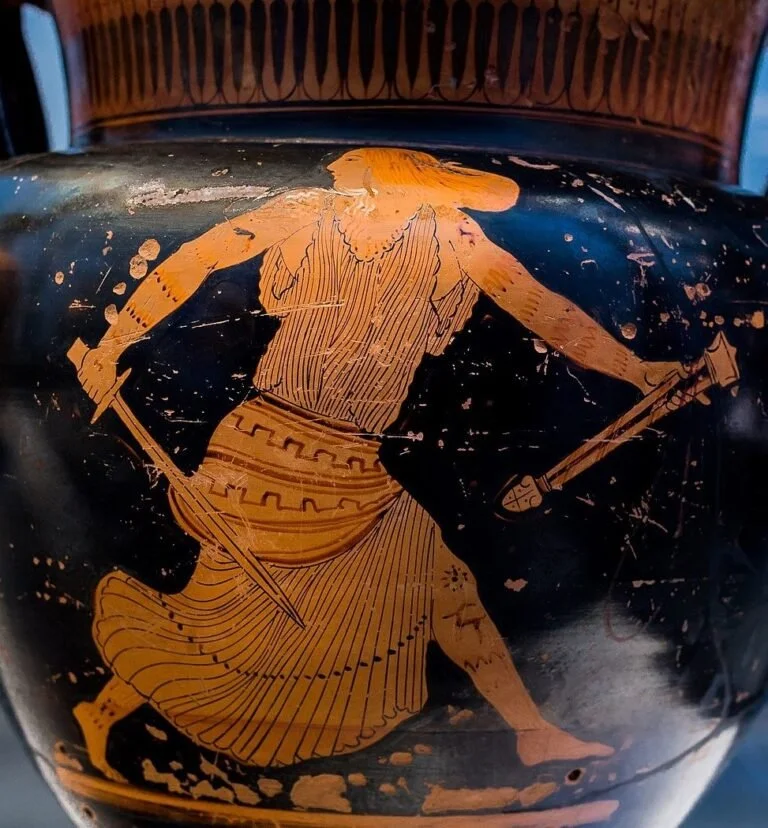
Attic red-figure vase (likely for mixing wine) depicting two Thracian women with tattoos on their arms and legs, the first of which is pictured with unsheathed sword perhaps in pursuit of Orpheus, who is not depicted
With the rise of Christianity, the practice of facial tattooing was banned by Emperor Constantine I around 330 AD, as he believed the face was made in the image of God. The Second Council of Nicaea (787 AD) would go on to ban all tattoos as it was then seen as a pagan practice. However, in medieval Europe it took on a uniquely complex role. Between the 5th and 15th centuries, tattooing existed at the intersection of religion, identity, and social control. While often discouraged or condemned by the Church, it persisted through pilgrimage, warfare, and cultural exchange—leaving behind a quieter but deeply meaningful legacy that would later influence the resurgence of tattooing in the modern West.
Medieval Tattooing: A Practice in Conflict
Medieval tattooing (approx. 5th–15th century) was a blend of spiritual devotion, punishment, and cultural marking. As Christianity spread across Europe, interpretations of scripture led many religious authorities to reject tattooing as a pagan or profane act. Yet this rejection was not absolute. Tattooing survived in specific contexts—particularly among pilgrims and Crusaders—where it was reframed not as defilement, but as devotion. This contradiction defined tattooing throughout the Middle Ages: forbidden in theory, but practiced in faith.
Pilgrimage Tattoos: Faith Carried on the Skin
The earliest records of pilgrimage tattooing in the Holy Lands stretches back to the 1560’s. For Christian pilgrims traveling to the Holy Land, tattoos became permanent proof of spiritual achievement. Journeys to Jerusalem were long, dangerous, and often life-threatening. Receiving a tattoo upon arrival served as both a religious symbol and a record of survival. Designs typically included crosses, saints, or sacred emblems such as the Jerusalem cross.
These tattoos held deep meaning. They were seen as a physical covenant with God—a mark that transcended death. In an era when proper burial rites were essential for salvation, a visible Christian symbol on the body could ensure recognition even far from home.
In one account from 1658, French Pilgrim Jean de Thévenot described how Christian tattooers “have several wooden moulds, of which you may chuse that which pleases you best, then they fill it with coal dust, and apply it to your arm, so that they leave upon the same the mark of what is cut in the mould; after that, with the left hand they take hold of your arm and stretch the skin of it, and in the right hand they have a little cane with two needles fastened to it, from which time to time they dip into ink, mingled with oxes gall, and prick your arm along the lines that are marked by wooden mould”
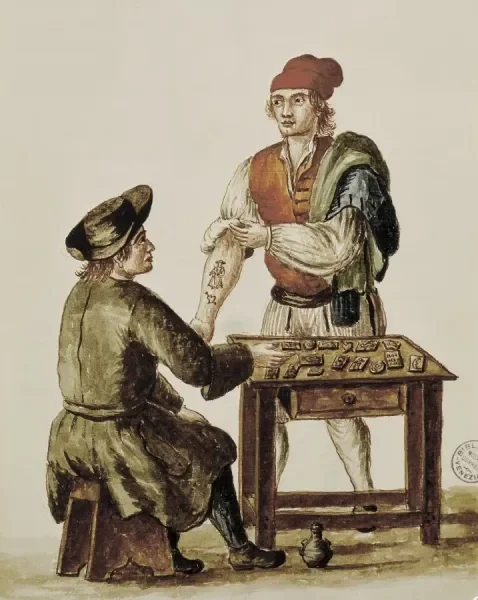
Eighteenth century painting documenting clothing and daily life of Venetians. Among the various occupations is this illustration of a tattoo artist called Giovanni Tebaldino, with a customer showing a tattoo. Wooden stamps are shown on the table.
The Razzouk Family: 700 Years of Tattooing Lineage
At the center of this tradition is the Razzouk Tattoo, widely considered the oldest continuously operating tattoo lineage in the world. The Razzouk family traces its tattooing roots back to Egypt before settling in Jerusalem around the 14th century. As Coptic Christians, they brought with them a long-standing tradition of religious tattooing, particularly the practice of marking the wrist or hand with a small cross as a sign of faith.
Our journey began with our ancestors, who carved intricate tattoo stencils from wood, inspired by biblical motifs such as the crucifixion, ascension, and the Madonna. These blocks became tools of devotion, used to tattoo pilgrims as tangible reminders of their faith and their sacred journey to the Holy Land.
By the time European pilgrimage to Jerusalem reached its height in the late medieval period, the Razzouks had established themselves as the primary tattoo artists serving Christian travelers. Using hand-carved wooden stamps—some of which are still preserved today—they would press a design onto the skin and then hand-poke ink into the outline. These stamps ensured consistency and allowed pilgrims to choose from a catalog of sacred imagery that had been refined over generations.
In 1956, historian John Carswell discovered a collection of 168 woodblocks in the Razzouk Tattoo shop, chronicling centuries of Christian tattooing. These blocks, described in his book Coptic Tattoo Designs, showcase motifs that resonate deeply with pilgrims, such as crosses, biblical scenes, and symbols of hope like olive branches. The Jerusalem Cross remains one of the most sought-after designs, embodying the spirit of pilgrimage and devotion.
The Razzouk family’s role extended beyond simple tattooing—they became cultural intermediaries. They connected Eastern Christian traditions with Western pilgrims, preserving iconography and methods that might otherwise have been lost during periods when tattooing was suppressed in Europe. Their work represents a rare, unbroken thread linking medieval tattooing practices directly to the present day.
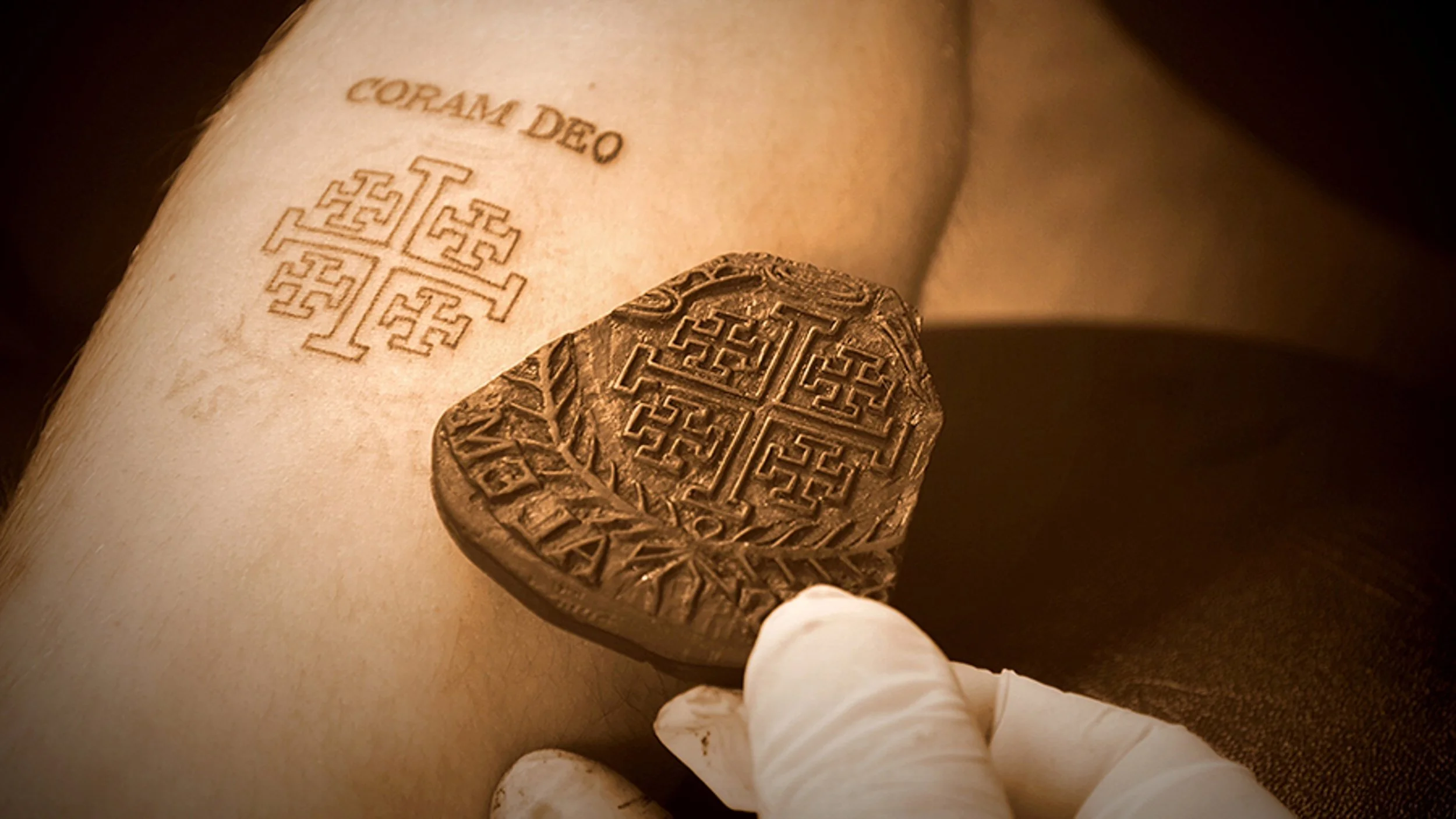
Stamp used by the Razzouk Family, this is the oldest documented stamp in their collection, dating back 500 years. Though partially broken, it beautifully preserves the Jerusalem Cross with an olive branch and a palm branch below it. The olive branchsymbolizes hope, inspired by the biblical story of Noah and the dove. The palm branch stands for joy and celebration, referencing Jesus' triumphant entry into Jerusalem. At the bottom, the word “IERVSALEM” is inscribed in Latin. The design originally included three crowns representing the Holy Trinity, and at the top, the Star of Bethlehemwith “Bethlehem” in Latin. The Jerusalem Cross itself is rich in symbolism—often interpreted as Jerusalem being the center of the world, with the four smaller crosses representing the Gospels spreading to the four corners of the earth. Some choose to fill it with red ink, symbolizing the blood of Christ.
Crusaders and Sacred Identity
Tattooing also played a role in the Crusades. Christian knights and soldiers often marked themselves with crosses before heading into battle. These tattoos served both spiritual and practical purposes: they were declarations of faith and identifiers in death. If a Crusader fell in foreign lands, the tattoo ensured that their body would be recognized as Christian and buried accordingly.
In some cases, Crusaders reportedly vowed to receive tattoos upon reaching Jerusalem, reinforcing the connection between pilgrimage and warfare. The act of being tattooed became part of a larger ritual of devotion—an outward sign of inner faith during one of the most turbulent periods in medieval history.
Even the Knights Templar holds the mystique of Friday the 13th in tattoo culture which is often loosely tied to their legacy, whose dramatic downfall cemented the number’s ominous reputation. On Friday, October 13, 1307, under orders from King Philip IV, members of the order were arrested, tortured, and accused of heresy—an event that would echo through history as a symbol of betrayal and superstition. While there is no direct historical link between the Templars and tattooing itself, modern tattoo traditions have embraced the number 13 as a symbol of rebellion, luck, and defiance against fear.
Notable Figures and Early Accounts
While records from the Middle Ages are limited, several documented figures provide insight into the practice of tattooing during this time. One of the most notable is Felix Fabri, a 15th-century theologian and pilgrim who traveled to Jerusalem and wrote detailed accounts of his journey. Fabri described receiving a cross tattoo from local artists—likely connected to the same tradition carried on by the Razzouk family—highlighting how common the practice was among devout travelers.
Another frequently cited example, though slightly post-medieval, is William Lithgow, an early 17th-century explorer who documented his own tattooing experience in Jerusalem. His writings describe both the process and the significance of the tattoo, reinforcing the idea that this tradition persisted from the medieval period into the early modern era.
Harold II of England, the first known British royal to have tattoos, famously died at the Battle of Hastings, where his forces were defeated by William the Conqueror. In the aftermath, his body was reportedly so badly mutilated that it was difficult to identify, leading to later stories claiming he was recognized by distinctive markings on his body — his chest bearing the words “Edith” and “England”
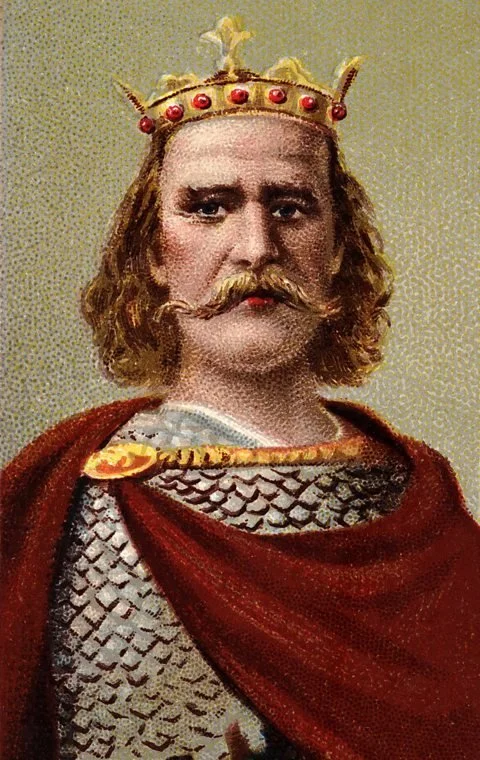
King Harold II of England, the first known British royal to have tattoos
Tattooing as a form of Self Identity
Between 1100 and 1600, tattooing in Europe underwent a profound philosophical and cultural transformation, mirroring a broader shift in how individuals understood themselves in relation to faith, society, and the body. Where tattoos had once been imposed as marks of punishment, enslavement, or exile in earlier empires, this period saw the gradual emergence of tattooing as a conscious, self-directed act—an outward expression of inward belief.
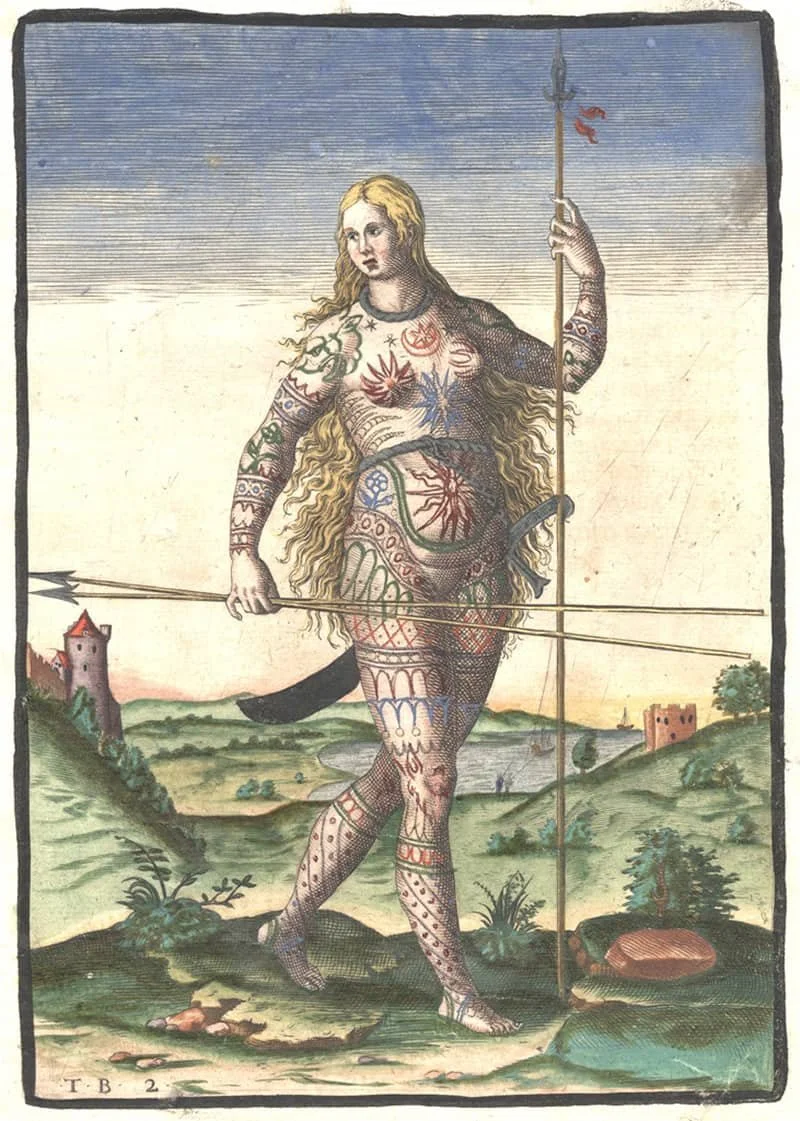
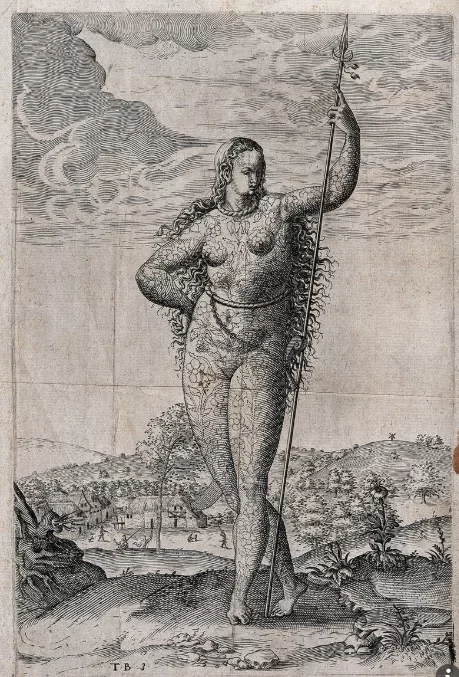
Pict woman by Theodor de Bry. From 7000 BC to around 845 AD, the Picts lived in the area of Europe now known as Scotland. They were covered from head to toe in elaborate tattoos, causing the Romans to refer to them as the “Pictii,” which is Latin for the “Painted Ones.” Animals were the main cause of inspiration for the tattoos of the Picts. They decorated their bodies with images of birds, fish, and various beasts of the region by pricking their skin with sharp bits of bone dipped in colored grasses, creating a blue hue for their permanent body paintings.
This evolution was closely tied to the intellectual awakening taking place across medieval Europe. The founding of institutions like the University of Bologna and the University of Paris signaled more than just the rise of formal education—they marked a growing preoccupation with the nature of the individual. Influenced by developments in theology and philosophy, scholars began to examine concepts such as personal agency, moral accountability, and the soul’s direct relationship with God. Christianity itself began to place greater emphasis on personal salvation, confession, and the responsibility of each individual to actively participate in their own spiritual journey
Tattoos—once forced upon the skin—were reinterpreted as voluntary symbols of faith, endurance, and identity. Pilgrims traveling to the Holy Land often chose to be tattooed upon reaching Jerusalem, marking not only their participation in a shared religious tradition, but their personal commitment to the journey. These tattoos functioned as permanent testimonies: proof of devotion, sacrifice, and lived experience.
This period reflects a subtle but important turning point. Tattooing was no longer purely collective in meaning—it became layered with individuality. A mark on the skin could still signify belonging to a religious group or cultural identity, but it also told a personal story. Each tattoo embodied a choice, a moment of transformation, or an act of will. The wearer was no longer just marked—they were declaring something about themselves.
The example of Coptic Christians illustrates this duality particularly well. Their tattoos, often small crosses placed on the wrist or hand, originated in part as identifiers under oppressive rule. Yet over time, these marks were embraced as expressions of faith and resilience. What may have begun as a means of control was redefined as an act of conviction—an intentional claiming of identity despite external pressures. In this way, the line between imposed and chosen began to blur, giving rise to a deeper, more complex understanding of selfhood.
By the late Middle Ages and into the early modern period, tattooing had shed much of its earlier association with stigma and punishment, at least in specific religious and cultural contexts. It became a medium through which individuals could assert loyalty, commemorate spiritual milestones, and express personal belief. This transformation reflects one of the earliest moments in Western history where the body was consciously used as a canvas for self-definition.
The legacy of this shift is still felt today. Modern tattooing, rooted in individuality and self-expression, echoes the same impulses that began to take shape centuries ago. What was once a mark of control became a mark of choice—an enduring symbol not only of belief and belonging, but of the individual’s right to define themselves on their own terms.
It is often assumed that tattooing disappeared in the Middle Ages due to religious decrees. However, tattoos feature in many representations of Christians. In Europe, tattoos were prevalent in the shape of pilgrims’ tattoos. Accounts and pictorial documents from the 16th to the 19th century, such as those by the Jerusalem pilgrim Ratge Stubbe, seem to have promoted secular tattooing back home. Stubbe was a 17th Century German Pilgrim from Hamburg/Itzehoe who received extensive, documented tattoos in Jerusalem in 1669. A 1676 engraving of his forearms show religious scenes — including the crucifixion, resurrection, and the Jerusalem cross — serving as an early example of “permanent ephemera” or “honorary stigmatization” worn by pilgrims. His tattoos are highlighted in Robert Ousterhout’s research as a prime example of Jerusalem pilgrimage traditions, predating Captain Cook’s voyages to Tahiti — often incorrectly cited as the start of modern western tattooing — by exactly 100 years
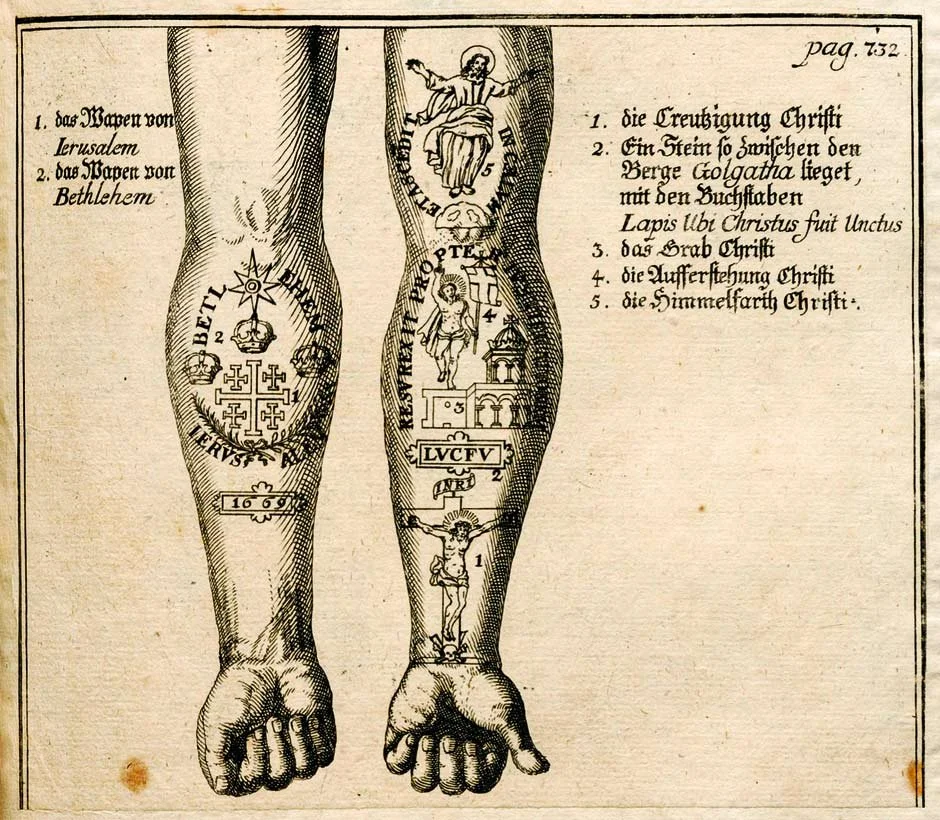
Ratge Stubbe was from Itzehoe, so this illustration is the oldest representation of a tattoo from what is now the greater Hamburg area. Thus, pilgrims and Christians also got tattoos in Europe, for example in Loreto (Italy) and in the Balkan region.