Rose Tattoo Flash Design Origins: Pharaoh’s Horses
The History, Meaning, and Tattoo Legacy of
Pharaoh’s Horses
The image known as Pharaoh’s Horses stands as one of the most enduring examples of how a single work of art can move far beyond its original context, embedding itself into popular culture and eventually into the skin of generations. Its journey begins in 19th-century England with the work of John Frederick Herring Sr., an artist widely respected for his vivid and anatomically precise depictions of horses. Herring, who rose from humble beginnings as a coach painter and sign maker, built his reputation painting racehorses, hunting scenes, and rural life, eventually earning patronage from British aristocracy. Among his many works, the composition that would later be called Pharaoh’s Horses—often also referred to as Pharaoh’s Chariot Horses—emerged sometime in the mid-1800s, most likely between the 1840s and 1860s.
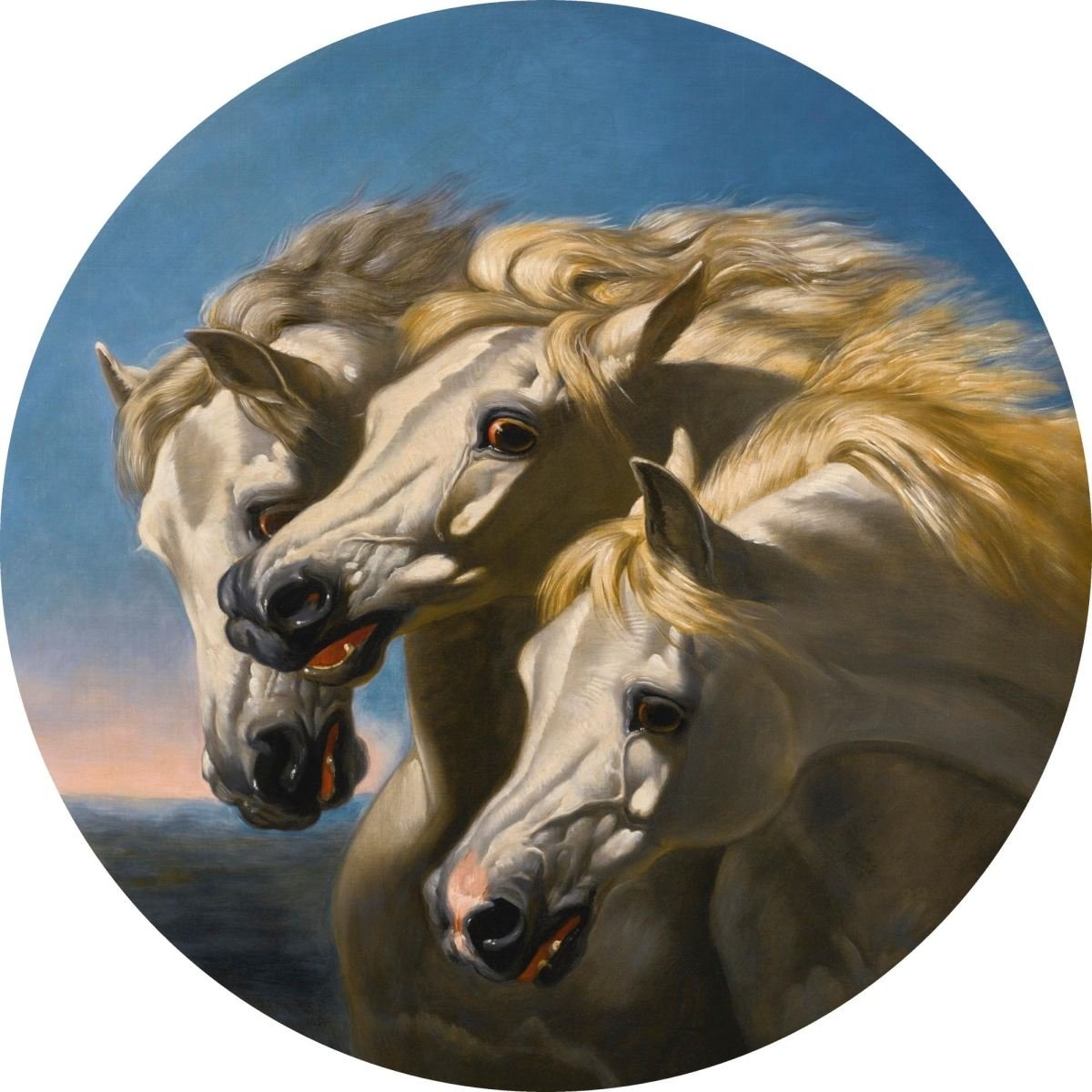
John Frederick Herring Sr. Painting of the classic Pharaoh’s Horses
The painting itself is deceptively simple yet compositionally powerful. It typically depicts three Arabian horse heads clustered tightly together, each turned in a slightly different direction, their expressions heightened with tension and movement. The horses appear alert, almost startled, as if reacting to something just beyond the frame. This subtle narrative ambiguity is part of what gives the image its lasting intrigue. While Herring did not explicitly tie the painting to a specific historical event, the title “Pharaoh’s Horses” evokes ancient Egypt and, more specifically, the biblical story of the Exodus. In that narrative—most vividly described in Exodus 14—Pharaoh’s chariots pursue the Israelites to the edge of the Red Sea, only to be swallowed by the returning waters after Moses parts them. The horses, in this interpretation, become symbols of power overtaken by divine force, of earthly authority meeting its limits.
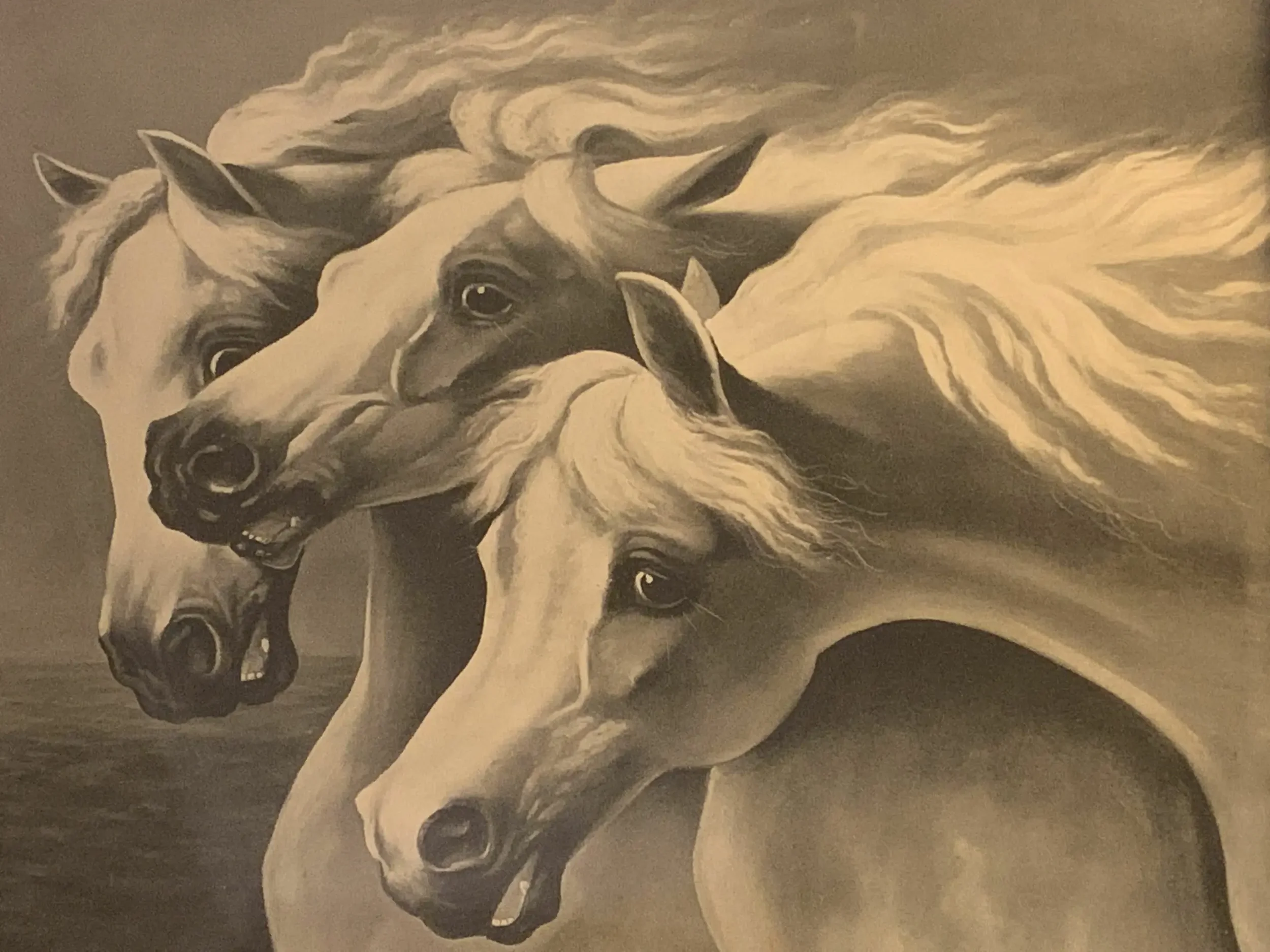
At the same time, the horses themselves draw from a broader historical and cultural symbolism. Arabian horses, often associated with the ancient Near East and North Africa, have long represented nobility, endurance, and war. In ancient Egyptian culture, horses were not merely animals but extensions of royal and military power, used in chariots that defined elite status and battlefield dominance. Herring’s decision to portray these horses in a tightly compressed, almost confrontational composition heightens their intensity. Rather than showing them in motion across a landscape, he isolates their heads, focusing on expression—flared nostrils, wide eyes, and flowing manes—to convey both strength and volatility.
The painting gained widespread recognition not just through Herring’s original work but through its reproduction. Engravings, particularly those created by Charles Wentworth Wass, played a crucial role in disseminating the image throughout Europe and the United States. By the late 19th century, Pharaoh’s Horses had become a familiar sight in homes, taverns, and public spaces. It was one of those rare images that transcended class boundaries—appreciated both as fine art and as decorative print. This accessibility is key to understanding how it later entered tattoo culture. Tattooing has historically drawn from imagery that is already widely recognized, emotionally resonant, and visually adaptable, and Pharaoh’s Horses met all of those criteria.
When the image began appearing in early 20th-century tattoo flash, it underwent a transformation that mirrored the broader evolution of tattoo design. Early American tattooers such as Gus Wagner and Bert Grimm were instrumental in adapting popular imagery into tattooable formats. The detailed realism of Herring’s painting was simplified into bold outlines, strong black shading, and limited but striking color palettes. The three-horse composition, however, remained intact. It was this structure that made the design so effective on skin: compact, balanced, and immediately recognizable even from a distance.
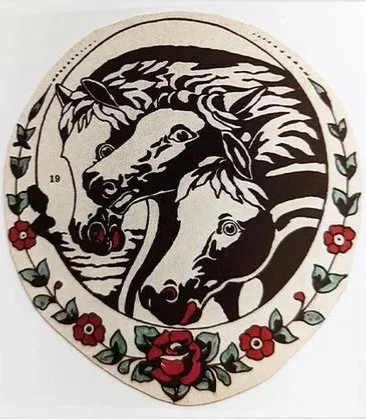
1950’s Milton Zeis Tattoo Design of Pharaoh’s Horses
As the design spread through tattoo flash sheets—particularly those distributed through early mail-order catalogues—it became a staple of American traditional tattooing. Its meaning, like many tattoo images, evolved in the process. While its origins may hint at biblical narrative or ancient symbolism, tattoo culture reinterpreted it more intuitively. The three horses came to represent power, freedom, and raw energy. Their unified yet slightly divergent gazes suggested motion, tension, and individuality within strength. For many, the image simply “felt” strong, and that visceral impact was enough to secure its place in tattoo history.
The influence of Pharaoh’s Horses on tattooing extends beyond its own repeated use. It helped establish a visual approach that prioritized bold composition and emotional immediacy. The idea of taking a complex, fine-art image and distilling it into a form that could age well on skin became a defining principle of traditional tattooing. It also contributed to the broader use of animal imagery as a means of expressing human traits—strength, resilience, unpredictability—without relying on overt narrative.
Over time, the design has continued to evolve. Modern tattooers reinterpret Pharaoh’s Horses in a variety of styles, from faithful reproductions that echo Herring’s original realism to neo-traditional versions that exaggerate color and form. Some artists experiment with the composition itself, stretching or rearranging the horses, while others incorporate additional elements such as roses, daggers, or ornamental framing. Despite these variations, the core identity of the image remains unmistakable.
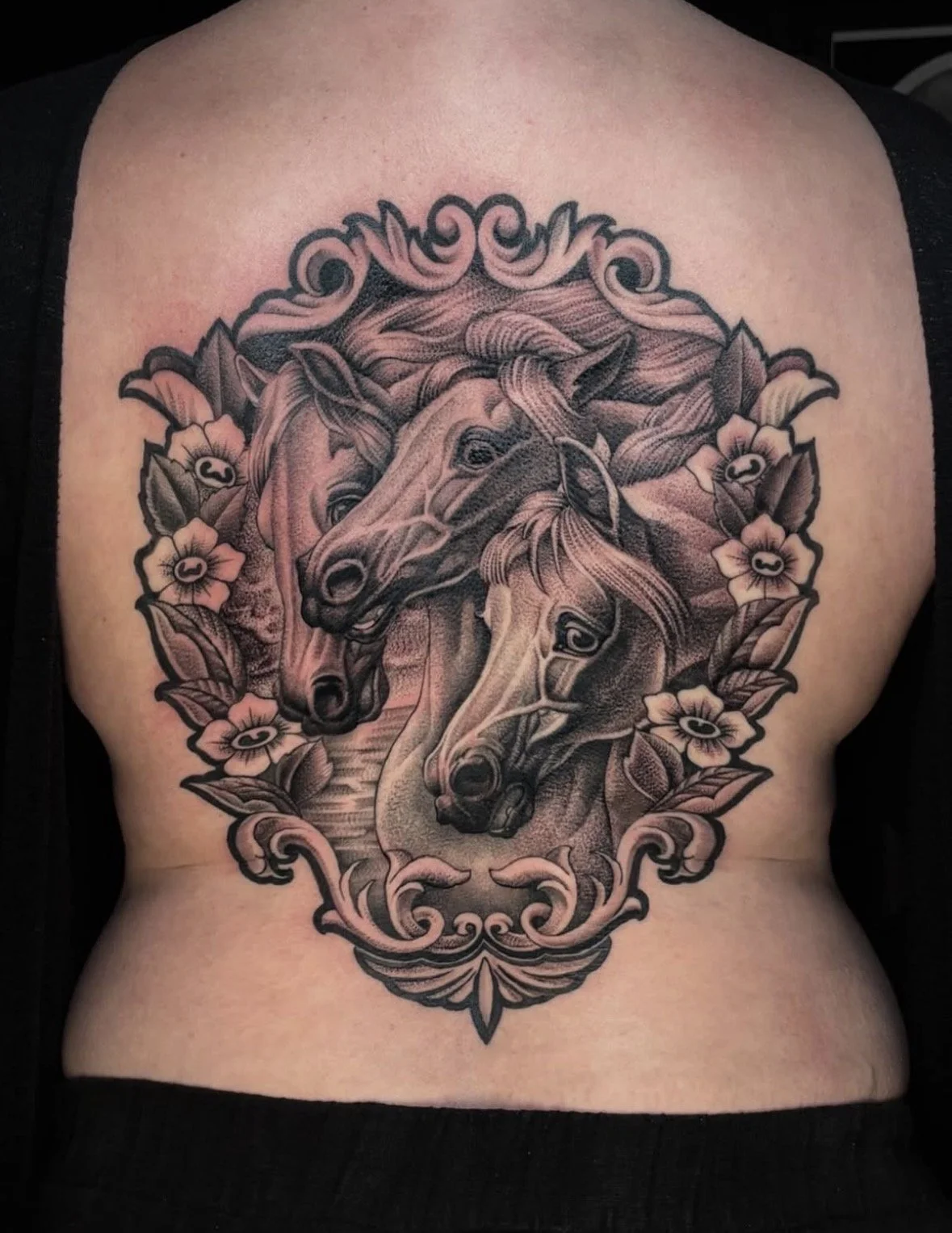
Start to a Pharaoh’s Horses back piece done by Daniel Collins at Rose Tattoo in Point Loma San Diego
What makes Pharaoh’s Horses endure is its balance between specificity and openness. It has a clear origin in 19th-century art, yet it resists a single fixed meaning. It can be read as a biblical reference, a symbol of power, or simply a striking visual composition. This flexibility has allowed it to move fluidly across contexts—from gallery walls to printed ephemera to tattoo flash—without losing its impact.
In the world of tattooing, where designs are constantly reinterpreted and passed down, Pharaoh’s Horses stands as a perfect example of how imagery survives by adapting. It is not just a reproduction of a painting but a translation of it—reshaped by each artist who redraws it and each wearer who gives it new meaning. From the hand of John Frederick Herring Sr. to the walls of early tattoo shops and onto modern skin, the image continues to carry forward a legacy of strength, movement, and enduring visual power.