The history behind “Professor” in Tattooing
The word “professor” has a surprisingly deep place in tattoo history. Long before tattooing became associated with contemporary art schools, conventions, celebrity artists, and professional studios, “Professor” was a title that appeared on the signs, business cards, flash sheets, and names of tattooers working in the late 19th and early 20th centuries.
It was rarely an academic title. Instead, it was part salesmanship, self-invention, professional status, and old-school tattoo culture—a way for a tattooer to present himself as someone who possessed specialized knowledge and mastery of an unusual craft.
The Tattooer as “Professor”
In the modern world, calling someone a professor generally implies an academic position. In the tattoo world of the late 1800s and early 1900s, however, “Professor” could function more like an honorific or professional nickname.
Tattooing was not yet a formally recognized profession with schools, licensing systems, standardized apprenticeships, or professional associations. Tattooers learned through informal apprenticeship, travel, military service, carnivals, sideshows, and relationships with other tattooers.
The title helped create an image of authority.
A tattooer wasn’t merely a man sitting in a shop with needles and ink. He could present himself as a Professor of Tattooing—a specialist who had mastered a mysterious and highly technical art.
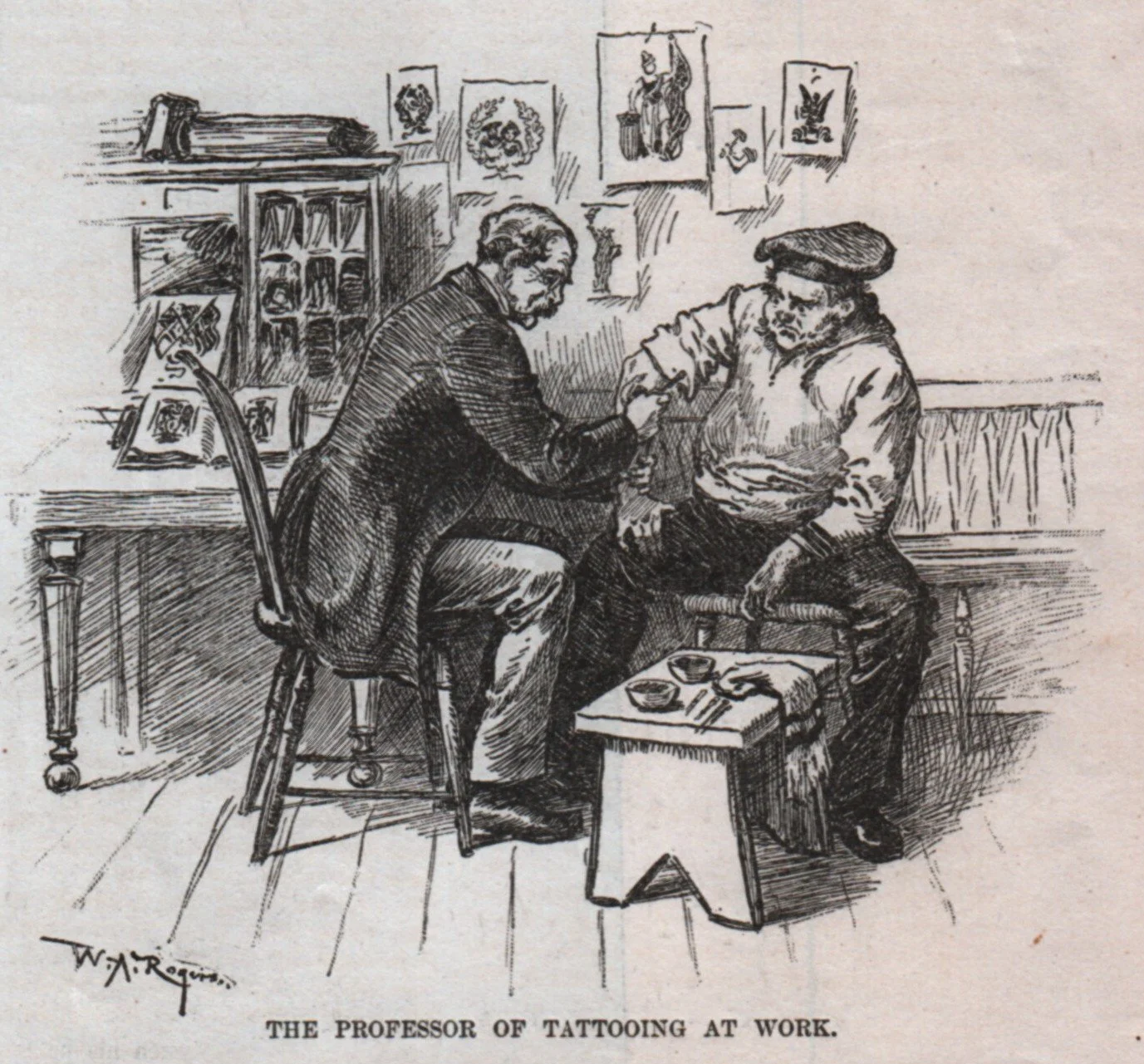
An 1888/1889 Harper’s Weekly illustration titled “The Professor of Tattooing at Work” depicts a tattooer identified as Professor Thomas working on a sailor in a South Street studio. The scene is significant because it shows that the title was already associated with tattooing in the United States during the 19th century.
And this wasn’t an isolated phenomenon.
Professor O’Reilly and the Rise of the Electric Tattoo Machine
One of the most famous early American tattooers associated with the title was Samuel O’Reilly, the New York tattooer who patented the first American electric tattoo machine in 1891.
O’Reilly worked in Manhattan’s Bowery and became one of the central figures in the development of modern American tattooing. His machine was based on Thomas Edison’s electric pen, adapted for tattooing.
O’Reilly’s influence extended beyond his own tattooing. He taught other tattooers how to use the new technology, helping establish a technical lineage that would influence American tattooing for decades.
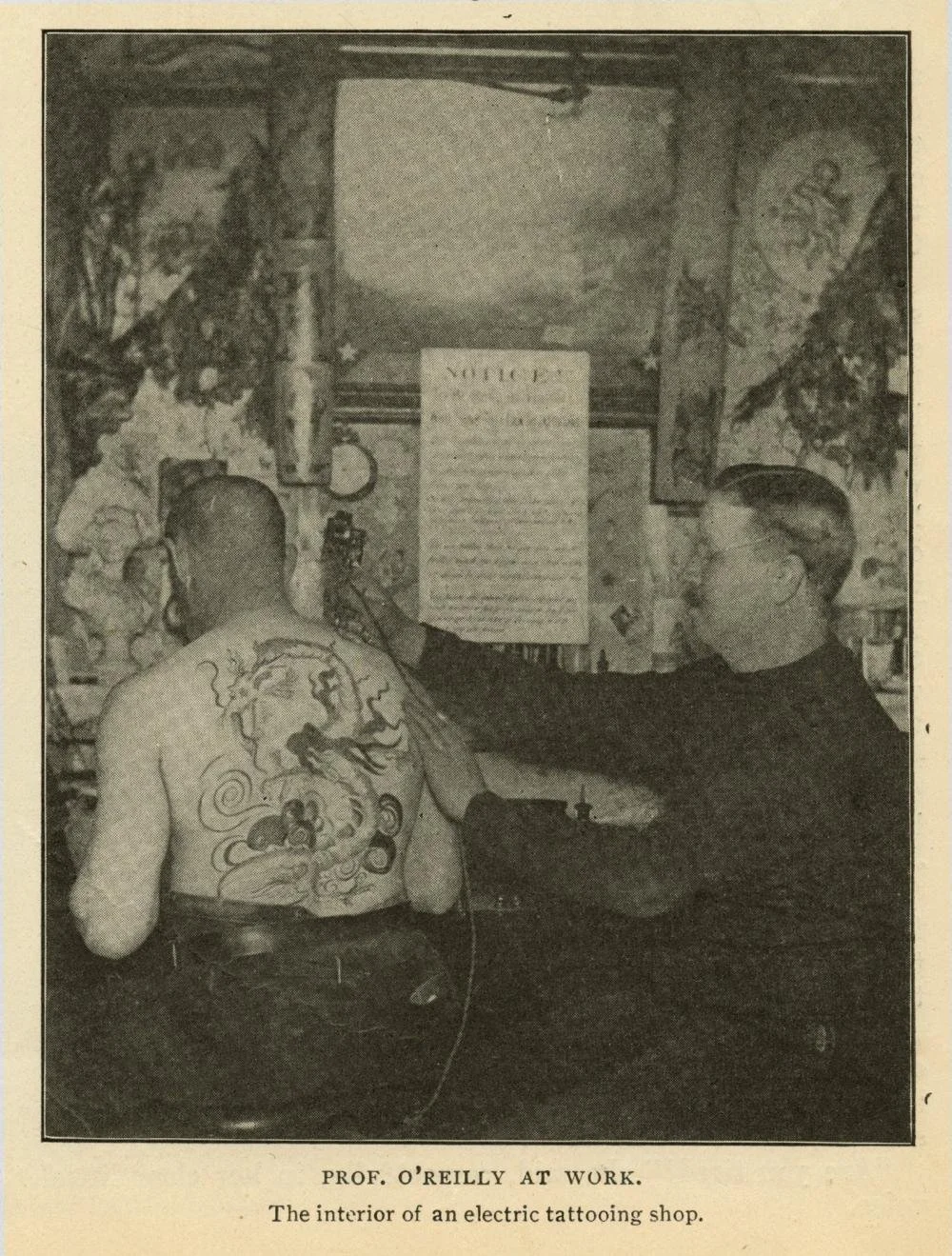
Among those tattooers was Charles “Professor” Wagner.
Wagner eventually took over O’Reilly’s famous Chatham Square location and operated there for roughly half a century. He also patented his own machine in 1904, introducing modifications that became influential in tattoo-machine construction.
The title therefore became attached to people who weren’t simply tattooing—they were developing the technology, teaching others, building businesses, producing designs, and establishing the craft itself.
Professor Percy Waters
Perhaps one of the clearest examples is “Professor” Percy Waters of Detroit.
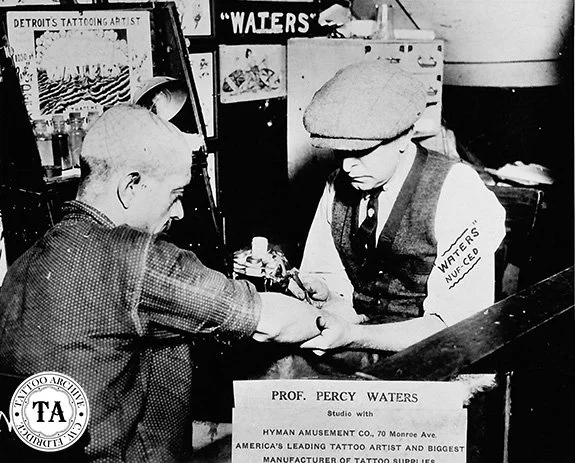
Waters (1888–1952) wasn’t an academic. According to The Henry Ford’s research on his collection, he adopted the title “Professor” in the tradition of early 20th-century tattoo artists and carnival performers.
His route into tattooing was itself typical of the period.
Waters encountered tattooing through traveling carnivals around his Alabama hometown. He subsequently traveled to New York’s Bowery to further develop his skills. His tattoo career existed alongside mechanical and industrial work, and he eventually became an important tattoo-equipment manufacturer and supplier.
His legacy wasn’t limited to tattooing clients.
Waters produced an extensive collection of flash and tattoo designs, operated a supply business in Detroit, and patented the two-coil tattoo machine in 1929. His approximately 1925 sketchbook contains hundreds of original watercolor designs.
In other words, “Professor Waters” wasn’t simply a colorful nickname.
He embodied something that became fundamental to traditional tattooing:
the tattooer as artist, technician, designer, teacher, manufacturer, and keeper of knowledge.
It Wasn’t Just an American Tradition
The use of “Professor” wasn’t confined to American tattooing.
In England, Tom Riley—born Thomas Clarkson—became known as “Professor” Riley. He learned tattooing during his military service and became one of the important English tattooers of the late 19th and early 20th centuries.
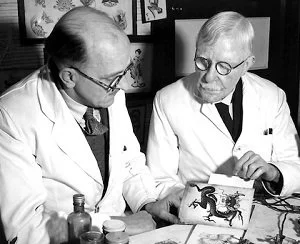
And perhaps the most famous British example is George Burchett, often referred to as George “Professor” Burchett.
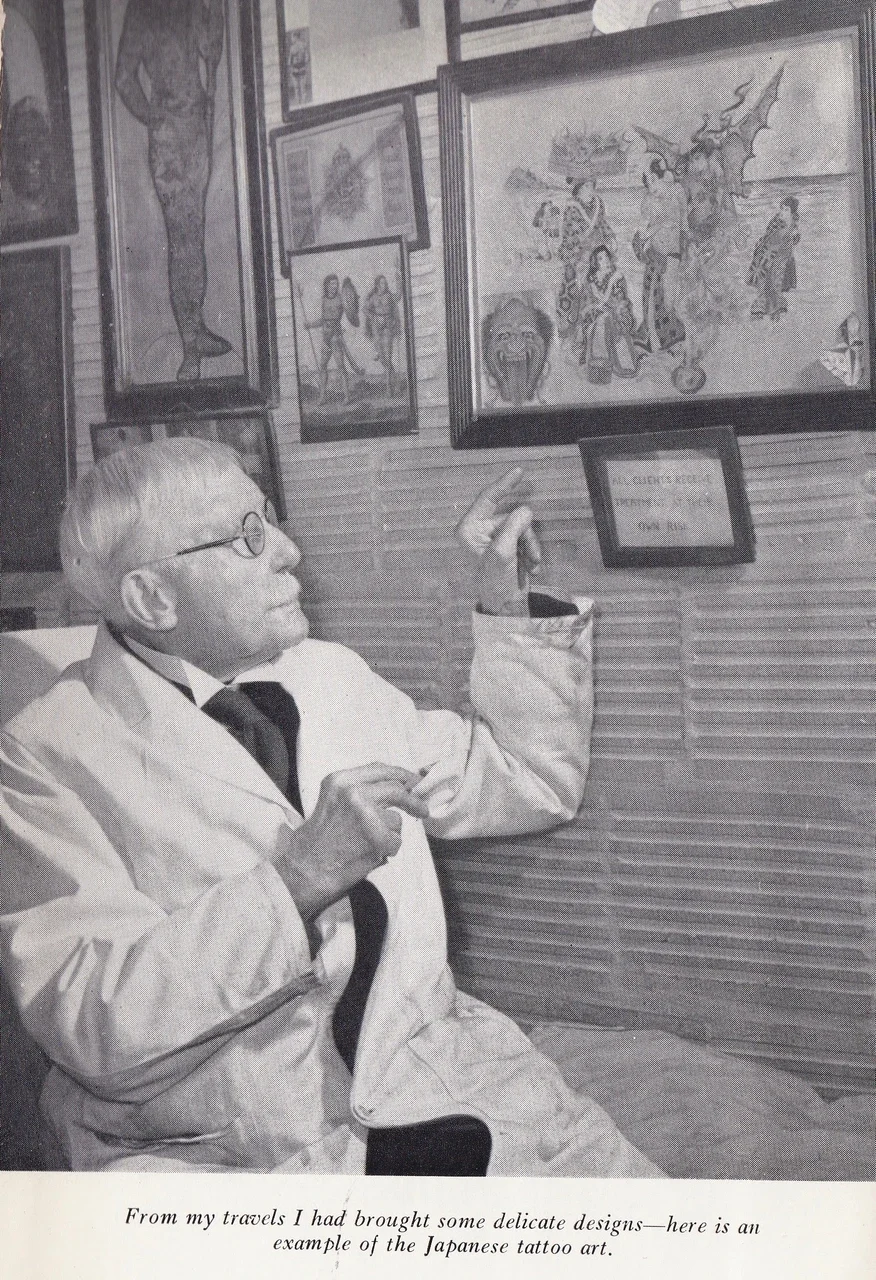
Burchett became one of Britain’s most celebrated tattooers, eventually earning the nickname “King of Tattooists.” He learned tattooing while traveling with the Royal Navy and established himself as a professional tattooer in London around the turn of the century.
That makes the title interesting historically: it wasn’t necessarily describing a particular style.
It was describing status within the tattoo trade.
Traditional tattooing has always depended heavily on knowledge being passed from one tattooer to another.
Before YouTube, Instagram, online tutorials, machine-building forums, convention seminars, or formal tattoo schools, knowledge traveled through people.
Apprentices learned from tattooers.
Tattooers learned from other tattooers.
They exchanged flash.
They traded machines.
They traveled to other shops.
They copied techniques.
They studied photographs and drawings.
They developed their own variations.
The tattoo shop became a kind of informal school.
This is one reason the modern tattoo apprenticeship remains so culturally important. Contemporary research into tattooing has found that apprenticeship continues to transmit not just technical skills but also a broader cultural code emphasizing history and tradition.
Professor Phil Sparrow
The word took on an entirely different—and fascinating—meaning with Samuel Steward.
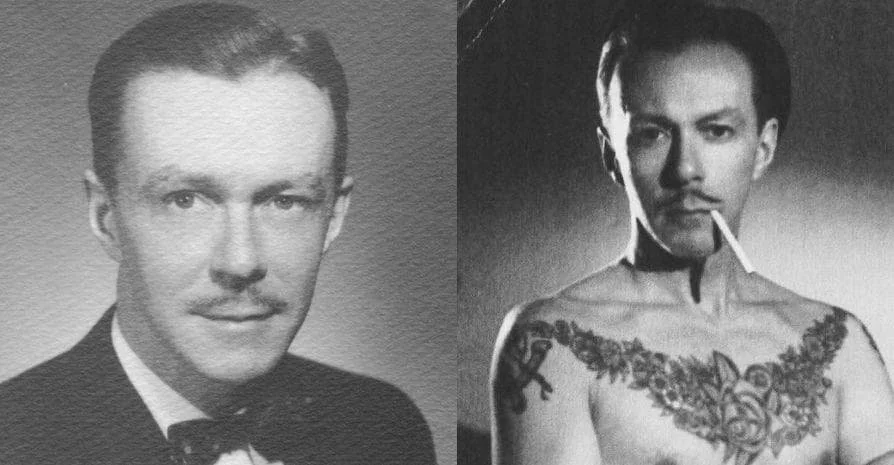
Steward was actually a university professor. He taught English before eventually becoming a professional tattooer under the name Professor Phil Sparrow.
For about 20 years of his life, Steward spent his days as an English professor teaching at various universities across the West and Midwest. But he had an abrupt end to his career at a small coed Christian school in Chicago. His life had become a mundane cycle of essentially teaching a group of intellectually uninspired individuals, and he began to loathe the underappreciated role of English professor, craving some excitement and debauchery in his life. He eventually broke away from his ties to academia and found himself on South State Street in Chicago getting his first tattoo.
In 1952, while still connected to academia, Steward began tattooing and adopted the name Phil Sparrow. He worked in Chicago and later in California, eventually becoming an important figure in tattoo history.
Steward’s story almost reverses the old tradition.
The early tattooers called themselves professors without necessarily being academics.
Steward was an actual professor who became a tattooer—and deliberately adopted “Professor” as part of his tattoo identity.
He also documented tattoo culture extensively, eventually writing Bad Boys and Tough Tattoos, an important firsthand account of tattooing among sailors, soldiers, gangs, and tattoo-shop culture.
His connection to Don Ed Hardy is particularly significant.
Steward introduced Hardy to Japanese tattoo imagery, helping open the door to traditions that would profoundly influence Hardy’s later work and, through Hardy, contemporary tattooing.
So the word “Professor” once again became connected with something deeper than a title:
the transmission of tattoo knowledge.
From “Professor” to “Master”
As tattooing developed through the 20th century, the terminology changed.
“Professor” became less common.
Other terms—master, old master, traditional tattooer, artist, craftsman, mentor—became more prominent.
But the underlying idea didn’t disappear.
A respected tattooer was someone who possessed knowledge that could be passed down.
This is especially visible in American traditional tattooing, where lineage remains enormously important.
A tattooer may be identified not only by what they tattoo, but by who taught them, who taught their teacher, whose flash they studied, whose machines they use, and which traditions they preserve or reinterpret.
The vocabulary changed.
The concept didn’t.
Why the Term Still Appears Today
Occasionally, modern tattooers deliberately call themselves Professor as a historical reference.
Contemporary tattooer and collector Nicholas York, for example, has used “Professor” explicitly as a reference to the early tattooers who adopted the title. His explanation was essentially that it connects modern tattooing with the period when tattooers used “Professor” to project knowledge and authority.
That gives the word a different meaning today.
An understanding that tattooing is a craft with knowledge that has to be learned and passed on. And, perhaps most importantly: A way of stating I’m still a student of the trade.
The Legacy of the Tattoo Professor
The title “Professor” tells us something important about how tattooing developed.
Tattooing didn’t become a respected art form because somebody suddenly decided that tattoos were art.
It evolved through generations of people who tattooed, traveled, apprenticed, invented machines, made flash, built equipment, opened shops, taught apprentices, and preserved what they had learned.
The early Professor wasn’t necessarily a scholar.
He was a keeper of knowledge.
Percy Waters preserved and produced designs and equipment. Charles Wagner advanced machine technology. O’Reilly helped establish electric tattooing. Tom Riley and George Burchett helped shape European tattooing. Samuel Steward documented the tattoo world while simultaneously participating in it.
Their titles reflected an old understanding of the tattooer as something more than a person operating a machine.
The tattooer was an artist, craftsman, technician, teacher, businessman, storyteller and historian—sometimes all at once.
That may be why “Professor” still feels strangely appropriate in a tattoo shop.
Because every legitimate tattoo tradition ultimately depends on the same relationship:
someone who knows, someone who wants to learn, and a craft worth passing on.
Sources
The Henry Ford’s Percy Waters collection provides particularly strong primary-source-based documentation of the early American use of “Professor,” Waters’ apprenticeship, flash, equipment work, and tattoo-machine development.
The San Francisco Maritime National Historical Park also provides useful historical context on tattoo flash, tattooers, and the relationship between sailors and professional tattoo artists.